
A Pitmaster’s Guide to BBQ Food Safety and the Temperature Danger Zone


SmokedBBQSource is supported by its readers. We may earn an affiliate commission at no extra cost to you if you buy through a link on this page. Learn more.
Whether you’re smoking a brisket, grilling chicken, or firing up baby backs, one thing no one wants is a side of food poisoning.
Food safety might sound like something for pros and caterers, but most foodborne illness actually happens at home.
I’ve been ServSafe certified for nearly 20 years. Whether I’m feeding a crowd or cooking for family, I follow the same rules every time. Why? Because temperature control is the number one factor in food safety, especially when it comes to meat.
Here’s what every pitmaster needs to know about the temperature danger zone, and how to keep your food safe, hot (or cold), and bacteria-free.
What is the temperature danger zone?
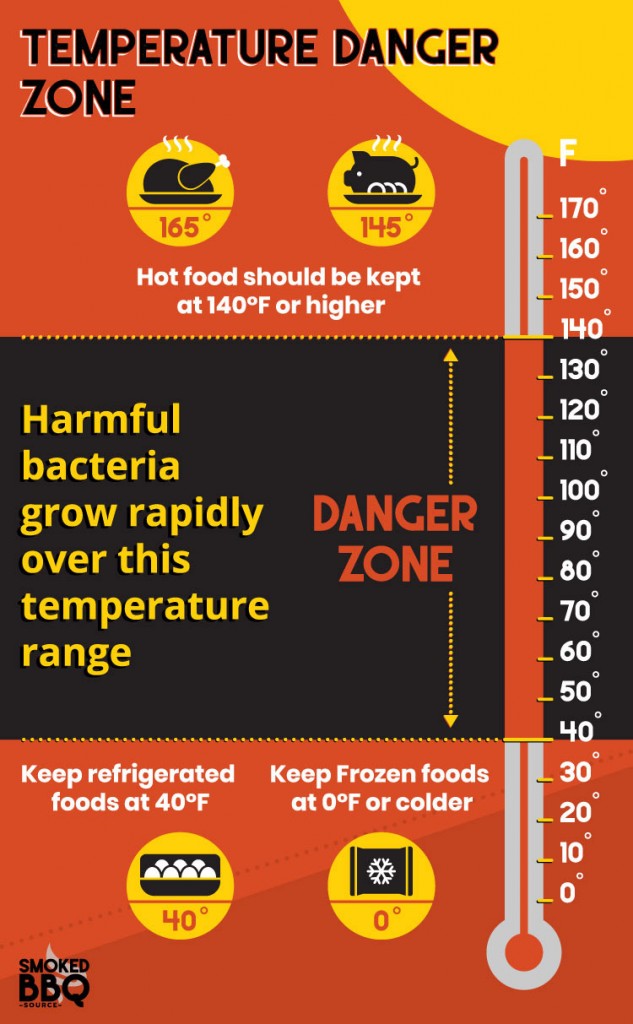
The Danger Zone is a buzzword phrase used in most food safety courses. It essentially refers to a range of temperatures at which bacteria thrive. Anytime food is between 40°F and 140°F, it’s in the Danger Zone, meaning that bacteria can grow rapidly.
Many people don’t know that it was also what Kenny Loggins was referencing in his song of the same name. Clearly he was passionate about food safety!
Jokes aside, most food already plays host to bacteria like E-coli, Salmonella, Campylobacter, Listeria, and Staphylococcus, but not in the quantity required to make us ill.
Leaving your food unrefrigerated in the danger zone allows those bacterial colonies to double in size every 20 minutes, growing to become a real problem.
According to the Center for Disease Control (CDC), 9.4 million people contracted a foodborne illness in 2011, resulting in 55,961 hospitalizations and 1,351 deaths, mostly children and the elderly. The most common cause of illness and death was salmonella.
How to rest BBQ safely
Keeping food out of the temperature danger zone is especially important in barbecue. Low and slow cooks often finish hours before it’s time to eat, and that resting period, while essential for juicy, tender results, is also when meat is most at risk of dropping below safe serving temperatures.
To hold meat safely after the cook, you need to insulate it. The gold standard is a Cambro Go Box or similar insulated carrier.

At home, you can DIY a “faux Cambro” using a regular cooler lined with towels. Wrap your meat tightly in foil, place it in the towel-lined cooler, and close the lid. If done correctly, this setup can hold food above 140°F for several hours.

If you’re serving buffet-style or plan to keep food out for more than 90 minutes, use warming trays with Sterno burners or electric warmers to maintain a safe serving temperature. Alternatively, keep most of the meat insulated and only portion out what you need every hour or so.
Safe serving temps for BBQ sides, salads, and sauces
In barbecue, the spotlight is usually on keeping meat hot, but cold food safety is just as critical. Think about that tray of potato salad sitting in the sun. If it’s been out for over an hour, you could serve up more than just a side.
The general rule is simple: cold foods should not sit out for more than 2 hours. That includes potato salad, coleslaw, pasta salads, sauces, and anything else that’s typically refrigerated. On hot days (85°F or higher) that window drops to just 1 hour.
If food isn’t being eaten, pop it back in the fridge or cooler. Don’t wait for someone to get sick.
To keep food cold outdoors, set your serving trays over ice. A full-size pan filled with ice can hold two half pans of food on top. Just be sure to refresh the ice as it melts to keep temps below 40°F.
How to store BBQ leftovers safely
Once the barbecue is over, food safety doesn’t stop. Proper storage is key to preventing spoilage and keeping leftovers out of the danger zone.
- Always store food in airtight containers with secure lids. This helps prevent contamination and freezer burn while keeping your fridge organized.
- Refrigerators should stay between 35°F and 38°F, and freezers at 0°F. This helps prevent bacterial growth and extends the life of your food.
- Leftovers should be eaten within 5 days if refrigerated. If you’re freezing them, they’ll keep safely for up to 6 months.
How to reheat BBQ leftovers safely
Leftovers, especially brisket, are one of the best parts of a good barbecue. But reheating them safely is just as important as how you stored them.
- Always reheat leftovers to an internal temperature of at least 165°F. This kills off any bacteria that may have grown during storage.
- Microwaves heat unevenly, so stir food every few minutes and rotate it if needed to avoid cold spots.
- Use an instant-read thermometer to double-check the internal temp, especially for meats or dense sides like mac and cheese.
A quality thermometer isn’t just for the smoker. It’s one of the most useful tools for ensuring your food is safe—whether you’re cooking, holding, or reheating.

About Your Pitmaster
Breanna Stark is a Texas-based competitive pitmaster and barbecue educator. She grew up cooking over charcoal and open flames while camping with her father, sparking a lifelong love of barbecue. Since 2014, she has competed in over 100 IBCA, KCBS, and CBA events, earning recognition for her award-winning chicken and Texas-style barbecue.
Passionate about recipe testing and development to create approachable dishes that help backyard cooks level up their barbecue skills. Breanna shares her expertise with over three million followers on social media.
An excellent and informative article, but I was left with an unanswered question. Many recipes call for meat to be allowed to come to room temperature after taking from the refrigerator before further processing. The article says that 2 hours at room temperature or 1 hour at 90 degrees F is probably safe for salads, sauces, etc. But, how about meat? And would those same time periods apply to hamburg, ribeye steak, chicken, finfish, shellfish etc.? I have a feeling that these time periods would be different for different groups of food products.
The reason that I’m interested in this subject is because I’m experimenting smoking with my tabletop Napoleon gas barbecue and I’m unable to get cooking temperatures lower than 325 degrees F without partially opening the top. Thus, things cook too fast and I get insufficient smoking. I’m considering the idea of smoking the meat right out of the refrigerator for a period of time before turning on the gas, but am concerned about bacterial growth.
There is a lot to unpack here, so bear with me. First off, many recipes may call for you to leave meat at room temperature prior to cooking but that is an outdated theory that have been disproven in recent years. The idea of letting meat warm to room temperature prior to cooking was based in the idea that you can get a better sear, but at the end of the day it doesn’t affect internal temperature nearly as much as we once thought. So, as far as that goes I would say to skip the “let it come to room temp” portion of most recipes.
As far as safe time at room temperature, those times are ballpark estimates based on standard room temperatures, ambient temperatures, etc. At the end of the day you just want to keep your food out of the danger zone (40°F to 140°F) as much as possible. It’s inevitable that meat is going to spend an amount of time at those temperatures during the cooking process, the serving process, and even the time it spends on your plate while you’re enjoying the fruits of your labors. The key here is that bacteria will spread more rapidly at those temperatures. A few minutes may not make a difference, and even a couple hours may be safe, but this is a guide for prevention to ensure that you don’t unnecessarily spread food-borne illnesses.
In reference to your experimentation on your gas grill, I’d say you’re potentially using the wrong tool for the job. While you can add smoke flavor to food on a gas grill by using smoke tubes, etc. they’re not really designed for low and slow cooking. There is a significant difference between a grill and a smoker. I generally don’t recommend trying to smoke meat on a gas grill, as they’re just simply not built for that type of cooking. If you want to try to get some smoke on your meat prior to the cooking process, then cold smoking is a viable option but you shouldn’t let it sit on an unlit grill for longer than about an hour prior to cooking.
Thanks! This article is very good for me. I am going to make sure to follow through the importance of resting my ribs after my next low and slow cook. The danger zone insight is very valuable for me too. The challenge is going to be for me to get my wife to understand! She’s stubborn and feels perfectly fine with hacking, and chopping up meats 🍖 and ribs IMMEDIATELY after they are pulled off the grill. I told her once about resting my cook for at least an hour and she looked at me as if I had purchased a 500 gallon offset smoker and had it delivered on her backyard oasis deck!
Another error on food safety. I hear this one constantly.
Once food is pasteurized (cooked) all bacteria that may have been present are dead. That’s why you cook it. If you then seal that food in an airtight medium, foil, plastic wrap, etc, there are no bacteria alive on the food to multiply. Therefore, the food can cool to room temperature with no danger of bacterial infection. Again, it must be sealed, and it must be cooked, which kills all bacteria if cooked to 160F or more for at least one minute.
The primary reason for using a cambro, etc, is to let the food finish cooking and to keep it hot for eating. It has nothing to do with bacteria.
Hi. I have a Bradley smoker that I do not use. I was thinking about using it as a holding oven for briskets. Any suggestions?
I have a few small electric smokers that I use for holding all the time! Set it to around 150°F-160°F and it works great, especially with a water pan in the bottom to create a DIY steam cabinet!