
Weber Searwood VS Camp Chef Woodwind Pro


SmokedBBQSource is supported by its readers. We may earn an affiliate commission at no extra cost to you if you buy through a link on this page. Learn more.
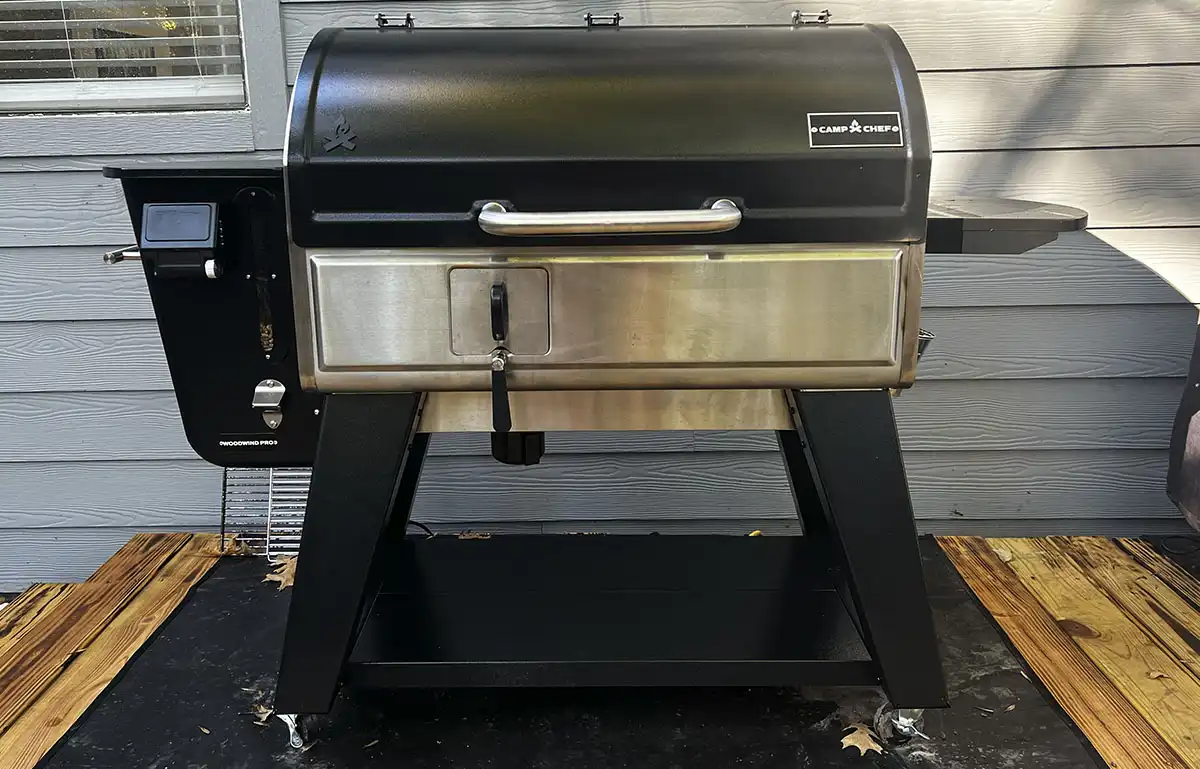
When Camp Chef launched the Woodwind Pro back in 2022, it instantly became our most recommended pit for barbecue enthusiasts.
The Pro offered beefed-up build quality and redesigned ventilation, but what got us really excited was the addition of the Smoke Box. By giving us the option to burn wood or charcoal throughout a cook, Camp Chef fixed our number one issue with pellet grills.
With the launch of the Searwood,
After cooking extensively on both pits, we’re putting them head to head to see how they compare across a range of categories, to help you decide which grill is right for you.
 |
 |
|
Pros:
|
Pros:
|
|
Cons:
|
Cons:
|
- Better smoke flavor with the Smoke Box
- Improved seal and build quality
- Expand functionality with Sidekick
- Smoke box could be bigger and easier to clean
- Direct flame searing across the entire grates
- Open lid grilling mode
- Adjustable smoke levels
- Option to add griddle and rotisserie attachments
- Some hot and cold zones
- Front and side shelves not included
Camp Chef VS Weber Overview
The Woodwind Pro and the
The right one for you will be determined by how you plan on using it, whether you’re just buying the base grill or considering the range of accessories and add-ons both companies offer. You can watch my video below where I go through how these two pits compare.
Both grills are available in two sizes, and the only difference between them is the square inches of cooking space.
Spec Comparison
| Woodwind Pro 24 | Woodwind Pro 36 | Searwood 600 | Searwood 600 XL | |
| Dimensions (IN) W*D*H | 50 x 26 x 44.5 | 62 x 26 x 44.5 | 38.5 x 23 x 45.75 | 50.50 x 23 x 45.75 |
| Weight (LBS) | 152 | 183 | 125.4 | 157.8 |
| Total Cooking Surface Area (IN²) | 811 | 1236 | 648 | 972 |
| Main Cooking Area (IN²) | 429 | 663 | 420 | 630 |
| Warming Rack Area (IN²) | 382 | 573 | 228 | 342 |
| Hopper Capacity (LBS) | 22 | 22 | 20 | 20 |
| Temperature Range | 60°F to 450°F | 60°F to 450°F | 180° to 600°F | 180° to 600°F |
| Probes | 4 (4 included) | 4 (4 included) | 2 (1 included) | 2 (1 included) |
| Warranty | 3 Years Limited | 3 Years Limited | 3 – 5 years | 3 – 5 years |
| Price | Check Price | Check Price | Check Price | Check Price |
On paper, the Woodwind Pro offers more grill real estate, but when you remove the warming racks and look at the main area, it becomes much closer.
Woodwind Pro VS Searwood Head to Head

In the following sections, we’ll compare these two pits’ smoke production and flavor, build quality, design, cleaning, and various other factors. You can also learn even more about each pit in our Woodwind Pro and Searwood reviews.
Smoke production and flavor
Both grills have smoke boost settings that can be adjusted via the digital controller or WiFi app.

On the Woodwind, you can adjust your smoke level between 1 and 10. This is a useful feature. Sometimes, you want to crank up the smoke for the first few hours and then back off. Or if you’re cooking for someone who doesn’t like a lot of smoke flavor, it’s handy to be able to dial it down.
You can also run the Woodwind in fan mode, which is great for cold smoking.
The Searwood has a Smoke Boost feature, but it’s not variable. It’s definitely not lacking in the smoke flavor department, although it’s still going to taste like it was cooked on a pellet grill.

What sets the Woodwind Pro apart is the Smoke Box. This lets you add a few wood chunks or some lump charcoal and brings the flavor profile closer to that of a charcoal or offset smoker.
If you’re one of the many people who find that food cooked on a pellet smoker lacks smoke flavor, then the Woodwind Pro solves that problem.


The heat from the firebox ignites whatever you load into the Smoke Box within a few minutes, and you can easily open the box and reload it throughout a cook.
You can also leave it empty if you’re happy with the level of smoke flavor.
It’s an amazing feature that gives the Woodwind Pro the edge if your focus is on smoking.
If we had to nitpick one thing, we wish they had made the Smoke Box a little bit larger. It can only fit a few small wood chunks or two to three pieces of lump charcoal at a time.
Grilling performance
After starting with the Woodwind’s killer feature, it’s only fair to give the Searwood a chance to punch back.
In all their marketing material,
But loading the Searwood with ribeyes, pork chops, and burgers forced us to admit that
While the right-hand side seemed to get a little hotter, we had no trouble getting a nice dark char on everything we cooked.

You can even run the Searwood like a gas grill by switching to manual mode for open-lid grilling. This comes in handy if you want to swap out the grill grates for a full-sized griddle insert.
As far as we know, the Searwood is the only pellet grill that can be used as a griddle with the lid open. This versatility is a theme we’ll keep coming back to.
Considering the relatively low max temperature, grilling on the Woodwind isn’t as bad as you might think.
We had no problem getting a nice char and rendering the fat on this reverse seared Picanha.

It also handled burgers without a problem.

If you want a really excellent sear, you’ll want to purchase the Sidekick attachment though.
The Sidekick replaces one of the side shelves with a powerful 30,000 BTU propane burner. You can then choose to connect a griddle, grill, or pizza oven top.

The cooking area is only 224 square inches, so it’s more useful for quickly reverse-searing a prime rib or thick ribeye steak, rather than grilling a huge batch of burgers.
The nice thing about the Sickick is that you can run it independently. So you can be smoking low and slow while you use the Sidekick to grill.
Since the Searwood can grill across its entire surface out of the box, we still think it wins in this category. At the time of writing, the 24″ Woodwind Pro with the Sidekick Sear will cost significantly more.
Design and build quality
The Woodwind Pro received several build quality improvements over the non-Pro model.
It’s thicker and heavier, and the legs and storage shelf feel very sturdy. Camp Chef also added an insulation gasket around the chamber’s doorframe, which helps prevent heat and smoke loss.

The stainless steel on the inside of the grill is 430 Stainless, and the valve, gasket, and burn cup are all made from higher grade 304 stainless steel.
The Woodwind has about a 25-pound weight edge over the Searwood.
The

All other parts and workmanship were high quality, so this could have just been an issue with an early-release model that we got for testing.
Above the fire pot,

Both the Woodwind and Searwood have ditched the traditional smoke stack design. The Woodwind uses what Camp Chef calls the “down & out” ventilation system.

They claim this allows the heat and smoke to circulate more before they’re pushed out of the rear through two adjustable vents.
We’ve been heavily pushing the Woodwind Pro since getting our hands on it in 2022, and it’s held up great. With the Searwood, it’s still early days, so we’ll update you in the next few years on how it’s holding up.

Grill grates
The grill grates on the Searwood are made from stainless steel and feel nice and heavy-duty. Given

I love that the top shelf on the Woodwind is made from two pieces. I usually just remove the top shelf on pellet grills because it gets in the way, but by removing half of the top shelf you can still fit a lot of extra food in while still having room to maneuver.

Prep areas, storage, and wheels
The Woodwind gets a slight edge when it comes to prep areas thanks to the inclusion of a side shelf (which you lose if you opt for the Sidekick).
Weber will charge you extra to add a folding side shelf, and both brands have folding front shelves available for purchase.
Otherwise, storage is virtually identical, with an open shelf at the bottom.
The

The Woodwind gives you four locking and rotating caster wheels, which is great if you like to bring the grill out of the garage whenever you want to fire it up.

Cleaning
We do not like the old-fashioned grease pot hanging off the side design. You really don’t want your dog or kids knocking that off and spewing old grease all over the place.
So it’s great to see

Lots of ash falls into this catch during a cook, and it’s great to be able to clean it out without removing all the grates and heat deflector.
The Camp Chef has a similar ash cleanout design, although the grease is still collected in a pot hanging off the side.

So long as you dump the ash between cooks, you should be able to comfortably go for 3-5 cooks without pulling everything out and doing a proper clean with a shop vac.
You’ll also need to dump out the Smoke box between uses.
Accessories
We already mentioned that you could swap out the grill grates for a griddle insert with the Searwood.

It’s amazing to be able to make pancakes for breakfast, smash burgers for lunch, and smoke ribs for dinner, all on a pellet grill.
You can also add a rotisserie attachment and remove the grates to get extra smoky flavor on rotisserie chicken or prime rib.

You can also add a few of the
With Camp Chef, the most exciting accessory is the Sidekick, which we already covered. You can fit this out with different accessories, including a grill or griddle top and even a pizza oven.
While it brings the total price up, it’s a great addition, especially if you want to run the Woodwind Pro as your only grill.
Controller and App
Both grills come with large color touchscreens and WiFi-connected apps that allow the grill to be controlled remotely.
The Searwood comes with the Rapid React™ PID Controller.
In our tests, the Searwood got up 225°F within about 6 minutes.

You only get two probe ports and only one probe included, compared to four on the Woodwind Pro (with four color-coded probes included!).

We like that you can cover the screen, and the dial on the side makes the screen easy to navigate.
The

Our experience with the app has been fine, but if you browse through reviews of the Camp Chef app in the App Store, you’ll find many users experiencing issues with poor connectivity and sluggish updates.

Unless the app experience is a huge factor for you, we don’t think there’s a vast difference here to swing our opinion of either pit.
Value
Weber cleverly priced the Searwood at $899.00, allowing it to compete with popular sub-$1,000 models like the Traeger Pro (which it completely destroys).
At the time of writing, the Woodwind Pro 24 goes for $1,199.99 without the Sidekick.
Is the extra $300 worth it for the slightly better build quality, side shelf and smoke box? Keep in mind that if you want high heat searing, you’ll need to splash out for the Sidekick Sear which bumps the price up to $1499.99.
We still think the Woodwind Pro is fair value, it’s just hard to argue that the Searwood isn’t slightly better value for moeny.
So which pellet grill comes out on top?
If you prioritize smoke flavor and build quality and see yourself mainly smoking low and slow, then the Camp Chef Woodwind Pro is the clear choice.
While there’s a pretty significant jump in price compared to the Searwood, you do get the side shelf included and better build quality.
The Searwood is a great all-arounder. Out of the box, you can grill across the entire surface area, so there is no need for costly add-ons like the Sidekick with the Camp Chef.
You’ve also got the griddle and rotisserie add-ons for added versatility.
You also can’t ignore the significantly lower initial cost of the Searwood. In our guide to the best pellet smokers, we gave the Searwood the top spot due to its versatility and lower price point, while the Camp Chef earned our best enthusiast pick.
Hopefully, this has made your decision easier, and you now know which pellet grill is right for you. Do you have a question about either pit? Just leave a comment below, and we’ll get back to you.
|
|
|
|
Pros:
|
Pros:
|
|
Cons:
|
Cons:
|
- Better smoke flavor with the Smoke Box
- Improved seal and build quality
- Expand functionality with Sidekick
- Smoke box could be bigger and easier to clean
- Direct flame searing across the entire grates
- Open lid grilling mode
- Adjustable smoke levels
- Option to add griddle and rotisserie attachments
- Some hot and cold zones
- Front and side shelves not included

About Your Pitmaster
Jeff “Ricer” Rice is the face of the Smoked BBQ Source YouTube Channel, where he brings expert BBQ equipment reviews and mouthwatering cook videos to life. A lifelong barbecue enthusiast, some of his fondest memories have been made around a pit, and he’s passionate about sharing that experience with others.
Whether he’s testing the latest gear or firing up the smoker, Jeff takes a real, no-nonsense approach to barbecue, making it easy for anyone to fire up great BBQ at home.
Looking at these two grills currently. In 2025, which grill take the top spot? I’m a Weber guy, thought the Campchef has my eye.
Hey Berklkey, have you watched our YouTube video comparing the Woodwind and the Searwood? Start there if you haven’t. The quick version is if you want to mostly stick with smoking, go the Woodwind Pro, if you want more versaility, high heat searing, griddle or rotisserie get the Searwood. The Searwood isn’t bad at smoking at all, and if you’re happy with Weber you can just go with your gut and stick with the brand you know.