
How to Cure and Smoke Your Own Bacon


SmokedBBQSource is supported by its readers. We may earn an affiliate commission at no extra cost to you if you buy through a link on this page. Learn more.
This recipe walks you through how to cure, smoke, slice, and store your own homemade bacon.
We’re starting with a classic maple bacon cure that brings balanced saltiness and a touch of sweetness to the meat, then finishing it with clean, gentle smoke to round it all.
It’s not the fastest process, but the payoff is smoky, savory bacon that pushes anything from burgers to breakfast to the next-level.
One reader, Caleb, commented: “Followed the process completely. Turned out phenomenal. My first use of pork belly since I began my “smoking” journey. Will definitely be doing this monthly. Family loved it. Awesome!. ★★★★★“
Another reader, Debi, commented: “After tasting this recipe, no other bacon compares! So tasty!! ★★★★★“
Why Make Your Own Bacon?
Sure, tossing a pack of bacon in your cart at the grocery store is easier. But when you make it yourself, you get full control over the flavor, quality, and process.
Here’s why it’s worth doing at least once:
- Flavor You Control – You choose the cure ingredients, the smoke level, and the final texture. Want a hint of maple? More smoke? It’s all up to you.
- Slice it How You Want – Thicker for breakfast plates, thinner for crisping up in a pan or layering into a sandwich.
- Better Ingredients – Whether it’s heritage breed or just a well-trimmed slab from your butcher, you’ll know exactly what’s going into your bacon. No fillers, no added water, and no surprises
Plus, serving homemade bacon on burgers or for weekend breakfasts is really the ultimate flex.

Nitrates and Curing Salt
This recipe uses Prague Powder #1, also known as pink curing salt. It’s a key ingredient for safely curing meats like bacon, helping prevent nasty stuff like Clostridium botulinum from setting up shop.
Some folks get nervous when they hear the word “nitrite.” That’s understandable. But just like fire, knives, and offset smokers, it’s all about using it properly. When measured accurately and used as intended, curing salt is a time-tested method that people have used to make bacon safely long before refrigeration existed.
This is a beginner’s guide focused on how to cure and smoke bacon safely, not a deep dive into the nutritional science. If you want to dig into the health debates or read up on the research, here are a couple of solid resources:
Ingredients you need
- Skinless Pork Belly – Look for even thickness. Around a 3 lb slab is ideal for home curing. Big enough to be worth the effort, but still easy to handle. You can often find them at Costco, Asian grocery stores, or ask your butcher to order one in.
- Prague Powder #1 – This pink curing salt is essential for preventing harmful bacteria and giving bacon its signature flavor and color. Measure by weight, not volume
- Kosher Salt – Use kosher salt, not table salt. Morton and Diamond Crystal measure differently by volume, so it’s best to weigh your salt.
- Maple Syrup – Adds a subtle sweetness that plays beautifully with the smoke. Use real maple syrup (not pancake syrup) for the best flavor.
- Brown Sugar – Balances the salt and brings depth to the cure. You can adjust up or down depending on how sweet you like your bacon.
- Black Pepper – Coarsely ground or cracked pepper adds a nice savory edge. Feel free to leave it out if you want more of a neutral, sweet flavor

What’s the Best Cut of Pork for Bacon?
Most bacon is made from either pork belly or pork loin, which are cured and sometimes smoked. In this recipe, we’re using pork belly for that classic bacon appearance and taste.
When choosing your pork belly, look for one with a balanced 50/50 ratio of meat to fat, with creamy white fat and firm pink meat. Avoid pieces that are overly fatty or thin on one end, as this can lead to uneven curing and smoking.

If your budget allows, look for heritage breeds like Berkshire, Duroc, or Kurobuta. These tend to have richer flavor, better fat quality, and superior texture.
How to Cure and Smoke Your Own Bacon
1. Prep your pork belly
Before you start curing, it’s crucial to trim and weigh your pork belly accurately. The salt and curing salt (Prague Powder #1) must be calculated based on the exact weight of your meat to ensure proper curing and food safety.
For this recipe, I started with a large pork belly from Costco and sliced it into two 3 lb slabs. If your belly is close to 3 lb, trim any uneven edges to square it up and get it as close as possible to 3 lb even. This makes it easier to apply the cure evenly and follow the recipe as written.

You can use our curing calculator to adjust the ingredients to fit your exact pork belly.
I prefer to buy a larger pork belly and divide it into smaller slabs for a couple of reasons:
- Better yield for your effort – Curing and smoking takes time, so you might as well end up with more than a snack. If you’re firing up the smoker, make it worth it.
- More room to experiment – Splitting the belly lets me try different cure blends in the same batch.

2. Make the cure
Curing draws moisture out of the pork belly and preserves it, while also building flavor before smoking.

For the best results, I highly recommend using a kitchen scale to weigh your ingredients in grams rather than relying on tablespoons. This is especially important for the curing salt, which needs to be precise for both safety and flavor.

Combine everything in a bowl and mix well until the sugar and salt are evenly distributed. Add the pork belly and coat well.

You can also apply the cure directly to the meat inside a zip-top or vacuum-sealable bag. This keeps things clean and makes sure all the cure stays in contact with the pork belly. Just massage the mixture all over the meat, making sure to coat every surface thoroughly.

Why We Use Grams (Not Tablespoons)
When it comes to home curing, you need to forget about freedom units and embrace the mathematical superiority of the metric system.
Curing salt isn’t something you eyeball. It contains sodium nitrite, which prevents harmful bacterial growth during the curing process. Too much can be unsafe. Too little and your bacon won’t cure properly.
Always measure by weight using a digital scale. Never round up, and never guess. Use only the amount specified for the weight of your pork belly. A little goes a long way. Adding more doesn’t make it safer.
3. Seal and wait for 7 days
Place the cured pork belly in a vacuum seal or Ziploc bag.
I recommend vacuum sealing if you have one, as the cure will draw out a lot of liquid from the pork belly, and you don’t want that escaping into your fridge. If you don’t have a vacuum sealer that’s OK, just make sure you get as much air out as you can.

Put it in the refrigerator for 7 days. You want to make sure that you flip the pork belly every day so that the juices and flavors move throughout the whole cut and don’t just sit on one side of the meat the whole time.
I like to get the little ones involved in this step. Pretend you’re living on a homestead, and make it a daily chore to flip and rotate the curing bacon!

4. Rinse, Dry, and Taste Test
After seven long days of flipping and waiting, your pork belly has officially become bacon. It should now have that deep pink color that signals it’s fully cured.

There’s one more important step before firing up the smoker, so you’ll need a little more patience.
Remove the bacon from the bag and rinse it thoroughly under cold water to remove the excess cure. Then, pat it dry with paper towels.


This is also the perfect time to do a quick salt check.
Slice off a few thin pieces, fry them up, and give them a taste. If the bacon is just a little salty, that’s fine. The smoking process will mellow it out. But if it tastes overly salty, soak the slab in cold water for an hour or two, then taste again. Repeat the soak if needed until you’re happy with the balance.

I picked up this tip from a great tutorial by Chuds BBQ. It’s a small step, but it can save your bacon, literally.
One of the most common complaints with homemade bacon is ending up with an inedible salt bomb, and this quick taste test is the easiest way to avoid that.
5. Dry the Bacon and Form a Pellicle
Place the rinsed and dried bacon on a wire rack set over a tray to catch any drips and return it to the fridge, uncovered, and let it sit overnight.

This final drying step helps the surface of the bacon develop a tacky layer called a pellicle. This tacky surface is like a magnet for smoke and gives you that signature mahogany crust.
6. Smoking
Once your bacon has dried out in the fridge overnight and developed a pellicle, it’s finally ready for the smoker.
For best results, keep the temperature low and steady. This helps build smoke flavor without drying out the meat or rendering too much fat.
I smoked the bacon on my Camp Chef Woodwind Pro pellet grill at 165°F, which gave me excellent temperature control and clean, consistent smoke. You can smoke anywhere between 165°F and 200°F, but going much higher can cause the bacon to cook too quickly and lose moisture before absorbing enough smoke.

For wood, I used apple pellets for a mild, clean smoke that pairs well with the maple cure. Cherry is another great option with a deeper, fruitier flavor, and hickory delivers that classic, more intense bacon smoke. The amount of smoke flavor is up to you. Store-bought bacon is usually lightly smoked, so using more wood will give your bacon a richer taste when it’s cooked later.
The Woodwind Pro also allows you to burn wood chunks, so I added some apple wood for a little extra flavor.

Place the pork belly in the smoker once it’s holding temperature and producing thin blue smoke. Smoke until the internal temperature reaches 150°F to 160°F. I pulled mine at 150°F after about 5 hours. Times will vary based on the size of your pork belly and how steady your smoker runs.
If you’re short on time near the end, you can raise the temperature slightly to help finish it off.
Monitor closely with your smokers’ leave-in probe or use an instant-read thermometer like a Thermapen to check doneness.

7. Slice It Your Way
Once the bacon reaches an internal temperature of 150°F, remove it from the smoker and let it rest at room temperature for at least 30 minutes.
At this point your house smells incredible, the dog’s going nuts, and the neighbors are lining up with forks. But hold tight. You need just a little more patience.
Chilling the slab overnight makes it much easier to slice, especially if you want even, consistent rashers.

Now for the big question. Do you want thick-cut or thin-cut bacon?
If I’m serving bacon for breakfast, I like thick slices. If I’m using to make Jalapeño Poppers or Atomic Buffalo Turds or adding it to sandwiches, salads, or burgers, thinner slices work better.
If you’re going to make bacon often, I recommend investing in an electric meat slicer like this 7.5″ slicer from Meat!
A long slicing or brisket knife will get the job done, though. Take your time and slice against the grain for the best texture.
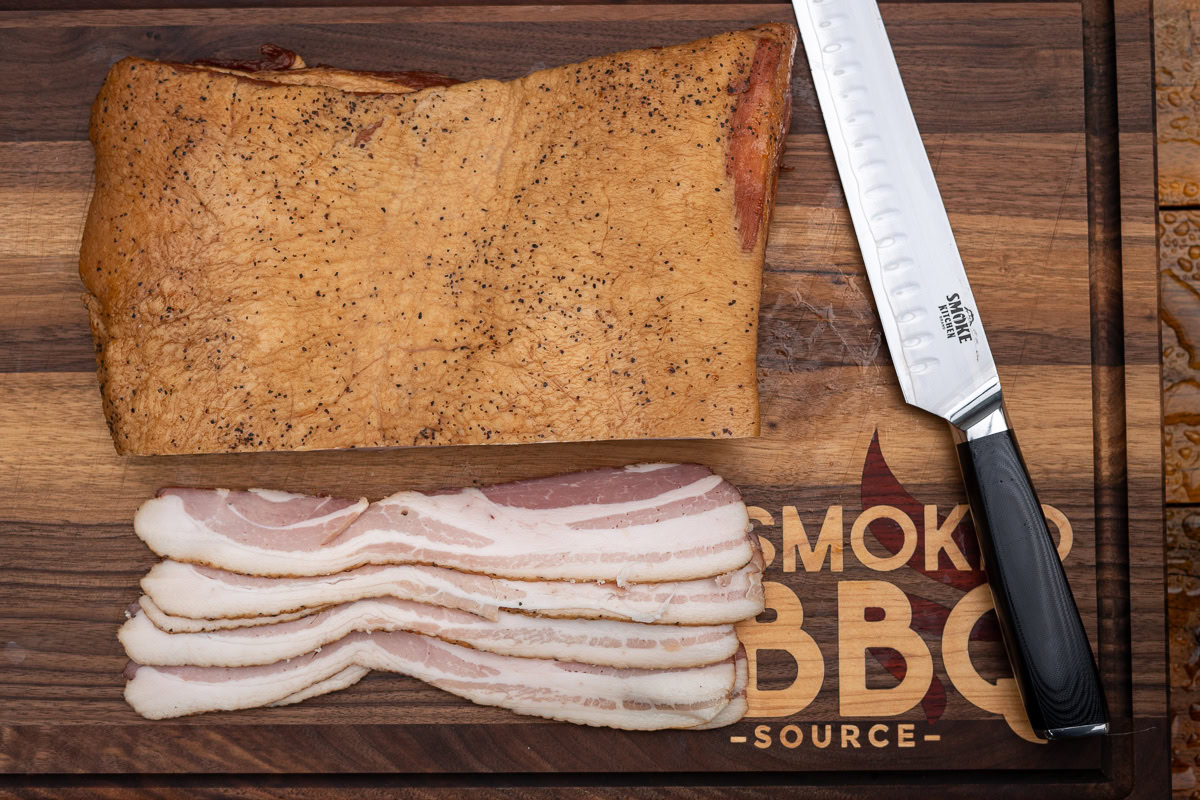
I cut most of the slab into a mix of thin and slightly fatter strips, then cube the uneven edge pieces into lardons. These are great for tossing into salads, making carbonara, or topping baked potatoes.
How to cook your bacon
After all that curing and smoking, don’t ruin your bacon by cooking it too hot.
Because of the sugar in the cure, homemade bacon is more prone to burning than store-bought. I recommend cooking it slowly over medium-low heat in a skillet or on the griddle to get crispy edges and rich flavor without scorching.
You can also bake it on a rack in the oven for even more even cooking.

Storing your bacon
Most bacon recipes will tell you that once sliced, bacon stored in an airtight container or bag in the fridge will keep for 7-10 days.
This conservative guideline is taken from commercial bacon after opening and covers liability and worst-case storage scenarios.
Properly cured and stored, homemade bacon often keeps longer than store-bought, but for safety, follow these conservative guidelines:
- Whole slabs can be wrapped tightly and stored in the fridge for up to 3 to 4 weeks.
- Sliced bacon will keep for about 2 weeks in the fridge if sealed in an airtight container or bag.
If the bacon ever smells off or feels slimy, it’s time to toss it.
The vacuum sealer comes in clutch for storing the bacon in individual packages, which is perfect for freezing. Bacon packaged and frozen correctly will hold its quality for 6+ months

Scaling this recipe
Use this calculator to adjust the cure quantities based on the weight of your pork belly. Since the maple is more of a flavor addition, it’s not included in the calculation.
Bacon Cure Calculator
The calculator is based on the following dry curing ratios:
- Prague Powder #1: 0.25 %
- Kosher salt: 2.5 %
- Brown sugar: 1.5 %
- Black pepper: 0.5 %
Now put your homemade bacon to use in these recipes


How to Cure and Smoke Your Own Bacon

Ingredients
- 3 lb skinless pork belly - see note 1 for advice scaling this recipe
For the cure
- 2 tbsp (34g) Kosher salt
- ½ tsp (3.4g) prague powder #1 - see note 2
- 1½ tbsp (20.4g) brown sugar
- 1 tbsp (6.8g) black pepper
- 2 tbsp (41g) maple syrup
Instructions
- Trim any uneven edges from your pork belly and weigh it. If it's close to 3 lb, proceed with the cure quantities listed. If it's more or less, use our cure calculator to adjust the ingredients by weight.
- Mix the cure by combining kosher salt, Prague Powder #1, brown sugar, maple syrup, and optional black pepper until fully blended.
- Rub the cure evenly over the pork belly, making sure all surfaces are coated. Seal it in a vacuum bag or zip-top bag, pressing out as much air as possible.
- Refrigerate for 7 days, flipping the bag once per day and gently massaging to redistribute the cure and liquid.
- After curing, remove from bag and rinse the pork belly thoroughly under cold water and pat dry. Fry a test slice. If it’s overly salty, soak the slab in cold water for 1–2 hours and test again.
- Place the slab on a wire rack set over a tray and refrigerate uncovered overnight to dry and form the pellicle, a tacky layer that helps smoke stick.
- Smoke at 165°F using apple, cherry, hickory or your preferred smoke wood until the internal temperature reaches 150°F, about 5–6 hours depending on thickness.
- Let the bacon rest for 30 minutes at room temperature, then refrigerate for at least 2 hours or preferably overnight to firm up for slicing.
- Slice against the grain to your desired thickness. Edge pieces can be cubed for lardons.
Notes
- 9 Tbsp salt
- 2/3 cup sugar
- 1/3 cup brown sugar
- 1 Tbsp fenugreek, or maple syrup
- 1 Tbsp paprika
- 1 tsp garlic powder


Nutrition
Nutrition information is automatically calculated and should be used as an approximation only. If you’re worried you could always add a side of kale.

About Your Pitmaster
Joe Clements is the founder and editor-in-chief of Smoked BBQ Source, a leading barbecue resource that has helped tens of millions master grilling and smoking. Growing up in a vegetarian household, his love for barbecue was unexpected. Determined to master the craft, he launched Smoked BBQ Source in 2016 to document his journey from amateur to pitmaster.
Joe leads a team of expert barbecue creators and oversees the largest collection of in-depth grill reviews and a library of tested, foolproof recipes. Whether he’s firing up a pellet grill or charcoal kettle, he’s passionate about making barbecue approachable and enjoyable for all.
The bacon was so salty after smoking and finishing in the oven was so salty it’s inedible. Not sure where I failed.
Hey Kenny,
Sorry to hear it didn’t work out! Just double checking, did you wash the the bacon thoroughly after the finishing the curing stage? That’s the main reason I can think it would be overly salty.
next time–after curing–place meat in clean water–some prefer warm water—-let soak for thirty minutes and it will draw lots of salt out of it–
Hi Kennny,
From what I understand, you cut a small piece, cook it and if it is too salty, you soak the slab in water 1 – 2 hours. If still salty, soak another 1 – 2 hours until you get the desired saltiness.
Normal equilibrium cure is 2% to 2.5% of meat weight, using cup etc measurements especially for salt is bad as salt crystal size changes which impacts the amount of salt. That is larger crystals is less salt. For 3lb (1.35kg) @ 2.5% that is around 35gm salt. Half a cup could be 125gm depending on the crystal size. Try with either dry or wet cure @ 2.5% see how you go.
Same! And I washed mine really well before I smoked it. Would love to know what else I might have done wrong. Such a great idea. Such an epic fail. I’m a novice griller so I’m sure the fault is mine. 🙁
Did you use Kosher salt? Regular table salt will make it way to salty. I have used close to the same recipe for over 20yrs brining for 10 days without that issue.
Kenny did you use 9.5 lbs of meat or entire amount of cure for lesser amount ?
Kenny did you use 9.5 lbs of meat or lesser amount with the entire cure recipe ?
Hi, I understand why your bacon was salty. 2tbsp per kg is huge. I have been making top quality bacon for years and it’s not salty at all. I use 2 level teaspoons per kg and one level teaspoon of Prague No. 1. You take a big risk not using curing salt. Do some research. The amount of nitrates in properly washed bacon is far less than a bag of salad leaves. John
We are raising American Guinea Hogs and have butchered some of the finest meat I have ever tasted. Even without smoking, it tastes like pure honey. We want to try out some different recipes and so I ended up here. I am so thankful that you are avoiding the use of nitrates. After all the hard work of raising these hogs using organic farming, I don’t want to waste that good meat and make it bad for my family. Nitrates are poison. Even a little bit gives me a headache for 3 days. We’re going to follow your instructions and enjoy healthy pork! Thanks so much!
Hi Kennny,
From what I understand, you cut a small piece, cook it and if it is too salty, you soak the slab in water 1 – 2 hours. If still salty, soak another 1 – 2 hours until you get the desired saltiness.
I just tried this recipe, and it’s great! My wife has been concerned about the black spots we got on the bacon (same as the ones in your “bacon on the smoker” picture). I figure there’s no problem since it’s all being fried up anyways, but she insists on trimming them off. Any idea what they are?
It might be water droplets that formed from condensation in the smoker that drip down on the meat. It’s black from the smoke. I didn’t notice any difference in taste but I put a loose aluminum foil tent over my pork belly to protect it from the drops.
You can Use Celery powder as a substitute for Prague. When you see uncured bacon at organic stores it is cured but not with chemicals but rather the natural way with celery powder. So I would highly recommend this.
Do some research on Curing with celery powder.
Hi Mike
It is the same chemical compound, similar to beetroot juice, difference being you don’t have a clear measurement on the nitrate level. Avoid them altogether, they are not needed at all, and they are the leading cause of colon and rectal cancer in UK.
Very tasty bacon. I do not buy bacon anymore. I did experiment by adding a touch of Jalapeno spice to this and it too came out great.
After tasting this recipe no other bacon compares! So tasty!!
Great instructional, however, do not use nitrates or nitrites, whether chemical or from celery/beetroot etc (it’s the same chemical). Nitrate/nitrite is bacon is the leading cause of bowel and rectum cancer in the UK. Nitrates are very good for us, however when mixed with a protein and applied heat, they change form to a nitrosomene, which causes cancer and recognised by the WHO as same level as smoking and asbestos. Nitrates were originally used many years ago to stop botulism (very nasty), however changes to our supply chain and refrigeration means we don’t get botulism anymore. Lots of research shows even at the recommended max dose of nitrate it does not actually prevent botulism, so why does the meat industry use it? It’s speeds up the curing process (cutting costs), keeps meat pink, which consumers like, and extends shelf life (profits) at the cost of cancer. I have done a lot of research into nitrate, helped by my wife who is a dr of food science, it is bad news. I have made comment on other US based smoking sites and been hammered for it, do your own research. It is not needed for home use, shelf life is not a problem, certainly in our house, and should be definitely be avoided. The critical ingredient in the cure is salt, add some pepper, maple syrup, bourbon..heaven
First time go with the recipe. Followed the process completely. Turned out phenomenal. My first use of pork belly since I began my “smoking” journey. Will definitely be doing this monthly. Family loved it. Awesome!
Ian
How would you cure and smoke bacon, ie. recipe
Didn’t this recipe used to have fenugreek powder in it?
Hey Denise,
We updated our bacon recipe a few months back to make a few improvements.
garlic so unnecessary if the meat is good overpowers the flavours might as well just use salt and G – its a pedestrian cook for sure i will not repeat
If you’re not a fan of garlic you can skip it! I personally love garlic!
I liked the old recipe. How much Fenugreek powder did it call for?
instructions said smoke until 150 degrees. notes said 160 degrees. which is correct?
150, sorry we made a typo in the recipe note.
Hello. Just need clarification. I am cooking this recipe Sunday. After I have smoked it and let it rest. Can I eat it straight up? Or do I need to cook it in the oven/fry pan?
You still need to pan fry it.
This article used to have a recipe for a pork belly cure WITHOUT curing salt/prague #1. I remember it also included Fennugreek powder. It appears the current version of the article & recipe has been edited & now the recipe does include curing salt. Is there anyway you could send me the old recipe that did not include curing salt/prague #1?
The original recipe we had was:
Ingredients:
Whole pork belly (around 9.5lb), or a piece at least 3lb
For the cure:
9 Tbsp salt
2/3 cup sugar
1/3 cup brown sugar
1 Tbsp fenugreek, or maple syrup
1 Tbsp paprika
1 tsp garlic powder
Instructions:
prepare curing rub by mixing all dry ingredients
Remove skin from pork belly
Apply cure to pork belly, making sure to cover entirely
Place pork belly into large ziploc bag or sealed container, and refrigerate for a week.
Flip daily, making sure the cure liquid covers the flipped side.
After a week, remove from fridge and rinse off cure.
Pat dry, and return to fridge on a rack over a tray overnight to dry and fro pellicle to form.
Set up your smoker to run at 200f, and smoke pork belly until internal temp of 160f, around 3.5-4hrs. Check internal temp regularly.
Cool, then chill in fridge overnight.
Slice to desired thickness and store.
I’ve smoked 5 slabs of pork belly so far. The recipe i use is almost identical to this one. I use a Bradley smoker and alder biskets.
Yes easy on the sugar and slow fry or you have burnt looking spots.
Very good bacon.
Loved the flavor. Great combo of sweet and salt. I cured it for 3 extra days as we had a snow storm here and it was too cold to use my charcoal and wood smoker. I ended up going to a friend’s house and using her Traeger with Apple wood pellets.
I wonder, from the people who said their bacon was too salty if maybe they used Morton rather than Diamond Crystal? Morton is considerably saltier than DC. Stopped using it years ago.
Your recipe says 3lbs. is that suppose to be Kilos? Everything says whole pork belly approx. 9.5lbs.
If you have a larger pork belly you can just scale up the rest of the ingredients. The one we used was 3lbs.
If something comes up during the time that its curing and I cant get to smoking it when I planned, is it OK to let the pork belly cure for longer than the 7 days?
You can let it go up to about 10 days, but I wouldn’t recommend much longer than that as the meat can start to break down.
been making bacon for 15 plus years with a very similar recipe, with a few twists.
Differences being:
add equal parts brown and white sugar to the mix.
mix in molasses with the maple syrup (1/2 cup : 1 1/2 cup). fuller flavor
slather the meat with the molasses / syrup mixture, generously sprinkle on coarse cracked pepper, then pat on mixture. Give it a whirl, might like it Rick H
Thanks Rick, I beleive I’ve tried it with a mix of white and brown sugar before, but never with molasses. I’ll have to give it a go. Cheers.
This was my first time making bacon and it came out awesome. I used my pellet smoker with a smoke tube and couldn’t be happier. I put it in the freezer to get it good and cold(not frozen) and sliced it on my meet slicer. Sliced some of it thinner for the wife and thicker for myself. Can’t hardly wait to do another batch.
Hi Joe, love your recipes.
With this recipe do you need pork belly in one piece or can you use 2 pieces.
Cheers
Thanks Reg! You can definitely use two pieces—as long as the total weight adds up, it’ll cure just fine. That’s actually what I usually do. For this batch, I started with a 6 lb belly and cut it into two pieces to make handling easier.
If you’re using a different weight of pork belly, just use the curing calculator on the page to adjust the ingredients accurately. Let me know how it turns out.
I don’t understand the 2025 update -pls clarify
thanks
Hi Hank, this receipe has been updated over the years, the note about the 2025 update simply explains what we changed. I’ve had a few people ask for the previous version of the recipe, so that’s what that is for. You can just follow the steps above though and ignore that note and you’ll be fine.
excellent and easy. Smoked with Pecan wood is the best taste ever.
The only problem with this bacon is I will never go back to store bought bacon. It’s great