
Guide to Wrapping Brisket: When, How and What With


SmokedBBQSource is supported by its readers. We may earn an affiliate commission at no extra cost to you if you buy through a link on this page. Learn more.

There are tons of recipes and how-to articles floating around the web about how to properly cook a brisket. Most will recommend that you wrap your brisket in the cook.
Ever wonder why? Like most things in barbecue, there’s a lot of history and myth involved.
We’ll do our best to explain when to wrap brisket, why you should wrap brisket, and look at the difference between wrapping in aluminum foil, butcher paper, or going ‘naked’.
Why do you wrap brisket?
Most pitmasters instinctively wrap their briskets (as well as pork butts and ribs) in either aluminum foil or butcher paper at some point during a cook.

Fast-track your brisket skills.
I’ve taken all of the most important information from our 37+ brisket recipes and guides and packed it into one free 25-page eBook.
Inside, you’ll get 6 step-by-step lessons to help you choose, trim, smoke, and slice brisket with confidence.
Usually, the wrap occurs once the internal temperature of the brisket hits 165°F. Some pitmasters will wrap based on just the appearance of the bark.
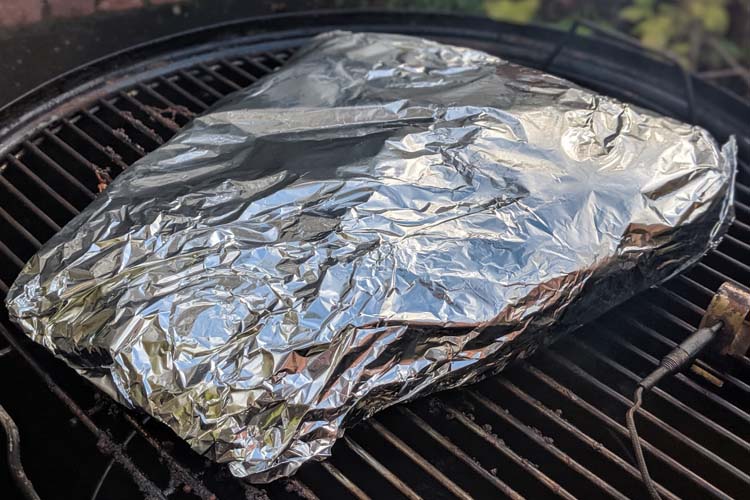
Not everyone will be able to tell you why they wrap brisket though. Maybe they have some understanding of why it’s a good idea. Maybe they watched Tuffy Stone do it on an episode of BBQ Pitmasters.
Either way, let’s break it down:
Pros
- Cuts down on cook time – By wrapping the brisket you are able to power through the stall and you can enjoy your delicious smoked brisket even faster.
- Keeps meat moist and tender – Brisket is a bit of a fickle beast; it needs to be smoked for a long period of time in order for the fat and collagen inside to break down, but if you cook it for too long it will begin to dry out. Wrapping it will help keep it moist and tender.
- Stops meat taking on smoke – Too much smoke can give your meat a lighter fluid flavor. Once it’s hit about 155°F internal temp more smoke won’t add much flavor.
- You can “hot-hold” for several hours – Once you remove meat from your cooker it will begin to rapidly cool down. An easy way to combat this is to “hold” your brisket in a dry cooler filled with towels (more on this later). By wrapping your brisket you can easily transfer from the cooker to your cooler with little to zero mess.
Cons
- Can ruin the bark – If you wrap your meat too early, or if you just cook it for too long while it is wrapped you run the risk of your bark becoming nothing more than a wet and mushy mess.
There are some clever ways to get around that, including boating or using butcher paper, which we’ll get into in a little bit.
What is the Texas Crutch?
You’ve probably heard the phrase “Texas Crutch” and wondered what the heck that has to do with wrapping brisket.
The term “Texas Crutch” has been thrown around for a long time. It simply refers to the act of wrapping your meat in tinfoil or butcher paper during the cook and it is a technique that is widely used on the competition barbecue circuit.
It is likely that the name started on the barbecue circuit as a tongue-in-cheek way of making fun of competitors who needed to give their food a leg up, or a “crutch”, over the competition.

Steven Raichlen, Beef Brisket Made Easy
“I used to wrap my brisket in aluminium foil (the so-called “Texas crutch”—practiced at the illustrious Snow’s BBQ).
I wrap when the internal temperature reaches 175 to 180 degrees.
Then I met Aaron Franklin, who smokes the best brisket on the planet. Franklin wraps his brisket in pink unlined butcher paper.
The advantage of butcher paper over foil is that it breathes, holding the moistness in the meat, but without making the bark (crust) soggy. Once you wrap the brisket, there’s no need to continue adding wood to your charcoal.”
The Texas Crutch doesn’t exclusively refer to brisket. You can use the technique with any meat. The popular 3-2-1 method of cooking ribs uses the Texas crutch. The numbers simply refer to 3 hours in the smoker unwrapped, then 2 hours wrapped in foil, with the final hour unwrapped at a slightly higher temperature.
How does wrapping barbecue work?
According to New York Times bestselling author and all-around barbecue genius Meathead Goldwyn of AmazingRibs.com, we wrap our meat in BBQ for two simple reasons:
- To create a tenderer and more juicy end product
- To speed up the cooking process and bust through the stall
When you cook a large hunk of meat like a brisket at low temperatures, the internal temp rises quickly at first. As the meat is cooking, the moisture that is inside the meat begins to make its way out from the center and evaporates on the center.
Eventually, the meat will stop rising in temperature while the moisture is trying to evaporate. This is called the “stall”.
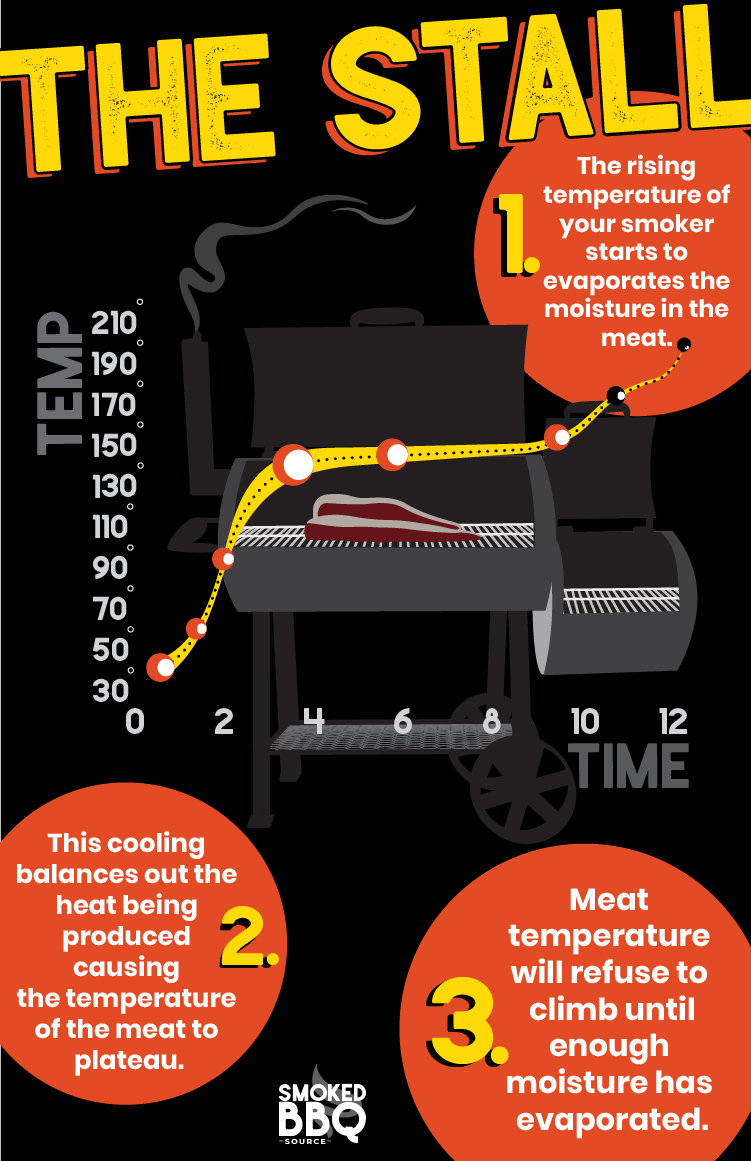
When the dreaded stall occurs, you have two options: you can wrap your meat, or you can ride it out.
By wrapping it, you can power through the stall because the moisture stays inside the foil or butcher paper.
In other words, you are braising your meat, allowing the internal temp to rise faster, and the finished product to be oh so moist and tender.
When to wrap brisket
There’s a lot of debate among barbecue experts on exactly when to wrap brisket.
I’m a believer in wrapping your brisket when two things have happened:
- After a dark bark has formed
- When the internal temperature has reached 165°F or when the stall hits (whichever happens first).
A leave-in probe thermometer is an invaluable tool when cooking brisket. If you don’t have one already, we have a guide you can check out.

Depending on the temp you are cooking at and a few other factors, that might not happen until after 4 hours, give or take.
Options for wrapping your brisket
There is more than one option when it comes to wrapping your brisket. Let’s look at what arguably are the three most common methods.
Naked
Just because most people wrap their brisket doesn’t mean you have to! An unwrapped, naked brisket will tend to take longer to cook, and you run the risk of it drying out before it is finished, but with some practice, you can still achieve a great brisket with a phenomenal bark.
Because there is nothing to interfere with the smoke and bark you’ll get to enjoy a super crunchy bark, and an extra smokey flavor.
Aluminum Foil
This is the method made famous by the good people from BBQ Pitmasters. By wrapping your brisket in tinfoil you will speed up the cooking process, and you will have a tender end product, but you do run the risk of ruining the bark you had begun to build up on the outside of your brisket.
The aluminum foil wrap results in the softest bark, and some complain that it can cause overcooked, or “mushy” brisket.
A common twist on this method is the aluminum foil ‘boat’ where you sit your brisket on a tray or ‘boat’ of foil at some point during the cook. Often you would also add some liquid for even more moisture

We use the boat method in our hot and fast beef brisket recipe so check that out to see the entire process.
Butcher paper
Made famous by Aaron Franklin of Franklin BBQ in Austin Texas; pink butcher paper has become closely associated with a certain style of Texas barbecue.

Fans of this method claim wrapping brisket in butcher paper give you the same benefits as wrapping in aluminum foil, while also being porous enough to allow some additional smoke to get in.
Butcher paper is more forgiving on the bark, so you should get to enjoy a little more crunch on your bark.
We sell our own brand of butcher paper in the Smoked BBQ Source store.
100% FDA-approved food grade butcher paper designed for wrapping barbecue. Made in the USA
We used the butcher paper method in our smoked pellet grill brisket recipe.
Aluminum vs butcher paper vs unwrapped
In the video below, T-Roy Cooks performs a test cook using three briskets: one naked, one wrapped in tin foil, and a third wrapped in butcher paper. He cooks all three on a Yoder Wichita offset smoker at 225°F.
The prep
The briskets T-Roy uses have been excellently trimmed right from the butcher. You might need to trim some of the thick fat cap off or do some other trimming on your briskets.
Trim the fat cap off a brisket or square up a rack of ribs in seconds.
He also rubs them in a simple seasoning of salt, pepper, and cayenne. You can do this or use our brisket rub recipe or any of your favorite store-bought seasoning.
The cook
Like I mentioned, T-Roy uses a Yoder Wichita offset smoker and cooks his briskets at 225°F. After several hours, he wraps two of the briskets—one in butcher paper and the other in tinfoil—and then puts them back in the cooker with the third unwrapped brisket and cooks them until they are finished.
- Butcher Paper – The brisket that was wrapped in butcher paper took 10 hours to cook. While it was still incredibly juicy and tender, it did not have a dark or particularly crusty bark.
- Tinfoil – The brisket wrapped in tinfoil was the fastest to cook at a total time of 9 hours. It had a notably darker bark and it was agreed was the most tender and moist. It also had a much more noticeable smoke ring.
- Naked – You notice immediately that the brisket that was cooked naked has a much darker bark than the other two. Total cook time for this brisket was the longest at 11 hours. It was agreed by all in attendance that this brisket had the most pronounced smoke flavor and the best bark. Not surprising as this brisket was cooked by smoke and heat for the entire 11 hour period.
We also have an aluminum foil vs butcher paper comparison that goes through when and why to use each product.
What the experts do
You don’t need to take my word that it is a wise choice to wrap briskets when cooking them! Daniel Vaughn of Texas Monthly Magazine spoke to many of the state’s foremost experts on the subject. Here’s what they had to say about wrapping and why they recommend it.
Smoke
Tim Byres is the pitmaster at this establishment, and he does things a little unique. Smoke uses a large smoker that is able to hold briskets at 175°F until service. The briskets that are first served for lunch are not wrapped, but the briskets they plan to sell later in the afternoon are wrapped in butcher paper until service.
Tim explains that this is to keep the briskets from drying out over time. He uses butcher paper because it is something that he has in abundance in the restaurant, but also because he feels it will allow moisture to escape and not turn the bark into mush.
Snow’s BBQ
Named the best ‘cue in the state of Texas in 2008 and again in 2017, it is no surprise that we would have to get the advice of the pitmasters at this establishment. Surprisingly, they use foil to wrap their briskets. The key difference according to owner Kerry Bexley is that they do not wrap the briskets until much later in the cooking process.
Pecan Lodge
At this iconic Dallas joint, briskets are also wrapped in tinfoil, but not until after they have finished cooking. Basically, the briskets are wrapped as they are removed hours before they are served. They are then hot held in an electric warmer while the smokers are used to cook more delicious ‘que.
Franklin Barbecue
No list would be complete without mentioning Franklin Barbecue. This restaurant was named the best barbecue in Texas for many years in a row (until recently knocked off its pedestal by Snow’s).
Owner Aaron FranklinAaron Franklin Barbecue MasterClass Review wraps his briskets partway through the cook in butcher paper. The brisket will stay in the butcher paper until it’s removed from the smoker and placed in an electric warmer hours before being served.
Aaron admits he started using butcher paper because it was cheaper than tinfoil, but that he holds similar beliefs to Tim Byres that the butcher paper will allow for the meat to breath and not dry out.
Louie Mueller Barbecue
Also known as the “Cathedral of Smoke”, Louie Mueller Barbecue has been in business since 1949 and has seen three generations of pitmasters running the business. Here they wrap their briskets once they are 95% complete in clear plastic wrap first and then butcher paper. After they come off the pit, they are held in a Cambro warmer.
Current owner Wayne Mueller swears that wrapping is a necessity and that if the step is skipped that the flat will dry out.
Resting Brisket
Whether you decide to wrap or not, you should always let brisket rest for at least an hour.
There is virtually nothing that can be done to improve the tenderness and moisture of a large hunk o’ meat like a brisket more than letting it rest after the meat has been cooked.
By letting the brisket rest you are allowing the internal temp to come down a little and allow for the moisture inside the meat to relax and not want to gush out of the brisket as soon as it is sliced.
Wrapping your brisket either during the cook or immediately at the end of the cook will make this crucial last step that much easier.

Meathead Goldwyn has developed an awesome method of holding meat he calls the “faux Cambro”. A Cambro is a food service product that is specifically designed to help caterers and restaurants keep food hot for hours after it is cooked.

Meathead Goldwyn, A Faux Cambro Can Save Your Butt, Turkey, And Save Face
You don’t need to buy a restaurant grade Cambro, you probably have one in the garage: A plastic beer cooler.
If you don’t have one, now’s the time to get one. Buy one large enough to hold a big turkey or packer brisket. Make sure it is well insulated, make sure it seals tightly, make sure it is easy to drain, and make sure it is easy to clean.
Wheels are a nice accessory. Buy an aluminium pan that fits inside to make cleanup easier, and keep a roll of heavy duty aluminium foil and one or two old towels in it when it is not in use.
To make your own faux Cambro, all you need is a cooler and some towels. You can pre-heat your cooler by adding hot tap water for 30 minutes before you add your meat.
Then dump out the water, lay some dry towels inside the cooler, and place your wrapped meat in the cooler. Meathead has had great results with this method and kept food warm for as long as 3 hours.
Brisket guides to check out
- Should You Cook Brisket Fat Side Up or Down?
- The Best Wood for Smoking Brisket?
- What Is Brisket? Where to Buy and How to Cook It
- Leftover Beef Brisket Recipes
- How to Slice Brisket
- Wagyu Brisket – Worth the Hype?
Wrapped vs unwrapped? It’s up to you
After taking a long hard look at the topic of wrapping brisket, my suggestion to you is simple: try different methods and see what works best for you.
You don’t have to go full-on scientist and cook three briskets side by side (although that could be a fun experiment!).
While myself and many professionals swear by wrapping briskets in both foil and butcher paper, you should not be afraid to try it once unwrapped and see what you think.

About Your Pitmaster
Joe Clements is the founder and editor-in-chief of Smoked BBQ Source, a leading barbecue resource that has helped tens of millions master grilling and smoking. Growing up in a vegetarian household, his love for barbecue was unexpected. Determined to master the craft, he launched Smoked BBQ Source in 2016 to document his journey from amateur to pitmaster.
Joe leads a team of expert barbecue creators and oversees the largest collection of in-depth grill reviews and a library of tested, foolproof recipes. Whether he’s firing up a pellet grill or charcoal kettle, he’s passionate about making barbecue approachable and enjoyable for all.
Good info Jeff , this will probably help out a bunch of folks who are still debating whether to smoke a brisket or not
Good read !!
Enjoyed the “brisket lesson” and the video. So much effort went into this acquiring special guests, and following up with the methods of the most famous bbq places in Texas. So great. While I’m still no expert, I can say that I like the brisket that I cook and I owe my success to a great grill, and listening to the experts!
Thanks much!
I have a roll of white butcher paper that has no discernible coating, glaze or finish . It was purchased at a GFS store by somebody else, so I never saw the original wrapping.
Is this the same as “pink” butcher paper? Or close enough to it that I can use it for wrapping?
So long as it’s food safe it should do the trick.
When using butcher paper, do you unwrap while it rests, or leave it wrapped (given butcher paper breathes unlike foil)?
Thanks for the great information!!!
Great information, Thank you.
Smoking a 17lb Brisket after trim on my 22 WSM for the first time and its breezy. Fingers crossed.
I have a whopping 2# brisket I bought at Costco. It’s only the flat with the point and fat cap trimmed off. It’s just my wife and I so don’t really need a 12# but curious on the cooking time and rest. Will wrap in butcher paper during the stall. Masterbuilt smoker set for 225.
I’ve cooked several briskets on my pellet smoker with good results. Some refer to me as a pit master but I still consider myself as refining my techniques. Since I live in central Texas, ambient temperature and weather conditions drive the decision to wrap or not wrap. In late fall and winter I always wrap at between 150-160.
Thanks, this article was a great help in clearing up the wrapping mystery to this beginner.
I always wrap my brisket in plastic wrap at 150-159 degrees.and foil .. JUICY!!! Haven’t tried the paper wrap be will do my next one that way .. I’m Treagering right now !,
Great info! Smoking my first Brisket right now! Pulled off at 160 wrapped in butcher paper! Well see how this goes!
Great read, doing a 4# brisket half (the big end) today. Never have I done brisket before but allot of what I read goes in line with what I was thinking, I’ve heard different temps before wrapping but I like the 150-160 idea. Would like a little more mediumrare middle. Guessing I’ll see how it goes
Drew a few days late on replying here. There is no med-rare on a brisket. It needs to be taken all the way to 195-205. If you do not you will have a chewy piece of meat. Also you need to cut across the grain or again the meat will be chewy.
Good luck and hope this helps
Drew a few days late on replying here. There is no med-rare on a brisket. It needs to be taken all the way to 195-205. If you do not you will have a chewy piece of meat. Also you need to cut across the grain or again the meat will be chewy.
Good luck and hope this helps
I feel I am far from being any where near described as a pitmaster but love smoking a brisket or two as the key meat for any BBQ I cook.
I smoke my brisket from cold, taken directly from the fridge for prep as I find this allows the brisket to take on a better smoke profile over taking the brisket out ahead of time and allowing it warm to room temp.
The brisket is cooked at 200°F, spritzing with a apple cigar vinegar and beef broth mixture half hourly from one hour until it hits 165°F and then wrapped in butchers paper. Depending on the ambient temperature this takes around six to seven hours.
I then take the brisket off at around 195°F and use the faux Cambro technique to rest it. Reason for taking it off at the lower temperature is that it does continue to cook a little after taking off and have found can result in the brisket being a little mushy if taken off and rested for an extended period. The longest I have rested it for to date is four hours without loss of temperature and quality.
The best feeling in the world is watching friends and family eat and enjoy the brisket that you have sunk love and time in to. Good BBQing all.
Looks like great technique to us Stan. Cheers.
Hi Joe, I’m making beef brisket in the oven. I’ve wrapped in double foil and had in fridge overnight with rub. Put in oven this morning at 275 degrees. When do I take tin foil off? I want bark , so do I take completely off and put on a wire rack in oven? First Brisket 😞. Thank you
Bark comes from meat being on the smoker, so you won’t be able to get it in the oven. Typically you would start unwrapped for the first part of the cook, and only wrap for the final few hours.
Tinfoil does not exist anymore. At least I got a grin out of it…
Like some others, I am called a ‘brisket king” by friends and family. I do not consider myself a pit master by any means! I will add a couple of thoughts here though.
1. Buy the best brisket you can find. I have smoked wagu briskets, and they are great, however my go to are Costco prime which I believe are pretty darn close to wagu in taste at half the price.
2. Get yourself a good quality remote meat thermometer. The first lesson I learned, the hard way years ago was never cook by time, cook by temperature. I put two probes in my brisket, 0ne in the flat, the other in the point and set the alarm for 170f. When the meat gets to 170, I pull it wrap in pink butcher paper and reinsert the probes and continue to around 203. I reset the alarms to 203 and go on about my business. At 203, off the pit and into a cooler, wrapped with towels.
3. Never stop reading or trying new “twists”. Write down what you do, so if it turns out brilliant, you can replicate it, and if it’s not so good you won’t make the same mistake again!
A good trick is to take the temperature into consideration, but what you’re really looking for is the brisket to be probe tender. The probe should slide in like it is sliding into a stick of softened butter. I’ve had this happen anywhere from 198 to even as high as 205 before. I totally agree with the sentiment to never stop trying new things – half of my favorite recipes and techniques are simply because I decided to try something new! Smoke on, my friend!