
Weber Searwood Pellet Grill Review: Have They Learned From Their Mistakes?


SmokedBBQSource is supported by its readers. We may earn an affiliate commission at no extra cost to you if you buy through a link on this page. Learn more.
Way back in 2020,
After much fanfare, the original SmokeFire was a colossal letdown, with early adopters suffering from several design flaws, from the faulty app to pellets failing to slide down the hopper. Oh, and there were the grills that caught fire.
The new Searwood is replacing the SmokeFire, so I was excited to see if
Over the last six months, I’ve been busy smoking, grilling, and even testing out the griddle and rotisserie attachments. In this review, I’ll share everything I’ve learned about this new pellet grill from

Weber sent me this griddle for free in exchange for an honest review. All opinions are my own.
UPDATED OCT 20, 2025: Added new section comparing the Searwood to the Weber Smoque.
Weber Searwood overview & first impressions


I was shocked when
The new Searwood lineup includes the Searwood 600 with 648 square inches of grilling space and the Searwood XL 600 with 972 square inches.
What you need to know:
| Searwood 600 | Searwood 600 XL | |
| Cooking capacity | 648 square inches | 972 square inches |
| Main grilling area | 420 square inches | 630 square inches |
| Secondary grilling area | 228 square inches | 342 square inches |
| Temperature Range | 180° to 600°F | |
| Weight | 125.4 | 157.80 |
| Probes | 2 (1 included) | 2 (1 included) |
| Warranty | 3 – 5 years | 3 – 5 years |
| Price | Check Lowe’s Price Check BBQ Guys Price | Check Lowe’s Price Check BBQ Guys Price |
Weber sent me the smaller 600 model to test out. The only difference with the XL is the larger cooking area, and you also get a fuel gauge to display your pallet level.
What I like:
- Full grate sear – While I noticed some hotter and cooler areas in my grilling tests, so long as you rotate your meat you can get edge-to-edge searing across the entire surface.
- Versatile – The option to add a rotisserie or swap out the grill grates for a full-sized flat top griddle surface makes this the most versatile pellet grill we’ve tested. You can also add on the
Weber -Crafted collection of accessories, including a pizza stone. - Rapid React™ PID Controller – This grill preheats faster and gets back up to temperature faster after you open the lid. You can even run it with the lid open for grilling.
- Variable smoke setting—This is a standard feature on more expensive pellet grills, but it’s nice to see
Weber add it to a sub-$1,000 grill. - Grease and ash clean up – Easy system for managing grease and ash means you don’t have to pull the grill apart to clean nearly as often
What I don’t like:
- Front and side shelves sold separately – Straight out of the Traeger playbook, these two accessories will cost extra.
- Grill grate choice – The grill grates are fine for smoking and easy to clean, but I preferred the grates on my SmokeFire stealth for searing.
Assembly and burn off
Everything came well packaged, although there are a lot of different parts so make sure you check each box and don’t miss anything.

Getting the cart put together was a little awkward. It’s definitely a job for two people. The biggest issue we ran into was fitting the bottom shelf. We missed a small bag of nuts and bolts, although we did receive an early model, so they may have packaged this better for retail orders.

The entire assembly took an hour and a half, although you could probably do it in under an hour if you didn’t make the mistake we did. So make sure you watch our entire assembly and burnoff video below.
Design and build quality
The first thing we noticed when putting this grill together was how rough the cut on the fire pot was. This was really surprising to see on a

Again, this could have been because we got an early-release model. It’s an interior part that gets covered by the heat deflector, so you’re never going to notice it, and it won’t impact the performance. All the other workmanship and interior materials were high quality.

Above the fire pot and heat deflector, you’ve got what looks like a huge version of the Flazorizer bar you find on

The grill grates are stainless steel, feel nice and heavy duty and are easy to keep clean, although I found the SmokeFire grates a little better for searing.

I’m not a big fan of the two wagon wheels with no castors on the other side. It’s the same design as the Traeger Pro, and I would much rather see some castors to make it easier to maneuver. That said, there is a heavy-duty side bar which makes it easy to lift up for moving.

You get a 20-pound hopper connected to the side, which is a lot more conventional than the Smokefire, which had the rear hopper and was a pain to fill up. You can change out pellets by pulling a handle.
The bottom shelf is also a nice addition and useful to keep a few bags of pellets off the ground.
Can you actually grill on this pit?
Almost all pellet grill brands make big claims about their grilling capabilities, and I’m almost always disappointed.
So, going into this review, I had some serious doubts that this grill would live up to its name.
I grilled up a batch of ribeye steaks, pork chops and burgers to see how well it performed.
I fired the Searwood up to its maximum temperature of 600°F and started by seasoning a batch of thick ribeye steak with salt and black pepper. The grill took 13 minutes to reach 600°F, which is impressive. I gave it a few extra minutes to allow the grates to get nice and hot.
I heard a satisfying sizzle as I placed the steaks on the grill and was pleasantly surprised to see some direct flame hitting the steaks.

The Rapid React PID controller seemed to be doing a great job of bringing the grill back to its maximum temperature each time I opened the lid to rotate the steaks.
I found the right-hand side definitely got hotter than the left-hand side, so I would recommend rotating meat around while you’re grilling. In my steak test, you can see the steak cooked on the right got a much darker char.
For my second test, I went with some pork chops and decided to rotate them to try and get a more even sear. This resulted in a much more even char across all the chops.

For my final test, I went with a batch of burgers to see how well it worked with the lid open. This is where my habit of not reading the manual backfired, as I didn’t realize you’re supposed to run the grill on manual mode for open-lid grilling.
Despite this stuff-up, the burgers developed a nice crust and tasted super juicy.

If you’re looking for a single do-it-all pit, but have been nervous about retiring the gas grill, the Searwood is the first pellet grill I’ve tested where I can confidently say that you will not have any problems grilling.
Smoking on the Searwood
I decided to smoke a batch of no-wrap ribs for my first cook on the Searwood to see how well it performs for barbecue. You can follow my whole experience in the video below.
First off, I used the pellet dump feature to remove the pellets I used on the burn off, so I could use some cherry pellets.
I fired the Searwood up to 250°F. Within about 6 minutes, the grill was already up to 225°F, and within 9 minutes, we were fully preheated. That Rapid React controller does a great job getting you up to temperature.

After a few hours I rotated and moved each rack to make sure each rack cooked evenly. The cook ended up taking a little longer than expected, but that could have just been because of not wrapping.
I ended up using my ThermoWorks Signals to check the temperature throughout the chamber. The controller on the
This isn’t unusual for a pellet grill, but I would definitely recommend rotating your food to ensure even cooking.
Once the ribs were done, I removed the grates to see if there was much grease or ash build up, and was happy to see that most of it has fallen down into the catchment system.

I also checked pellet usage, and was surprised by how little had been used throughout the cook.
The ribs had a beautiful smoke ring and were juicy with a good smokey flavor.
I followed this cook up with some beef spare ribs, with similar good results.

Rotisserie on a pellet grill
While I believe Green Mountain Grills has a rotisserie attachment for its pits, I’ve never used a pellet grill with a rotisserie, so I was extra excited to try the
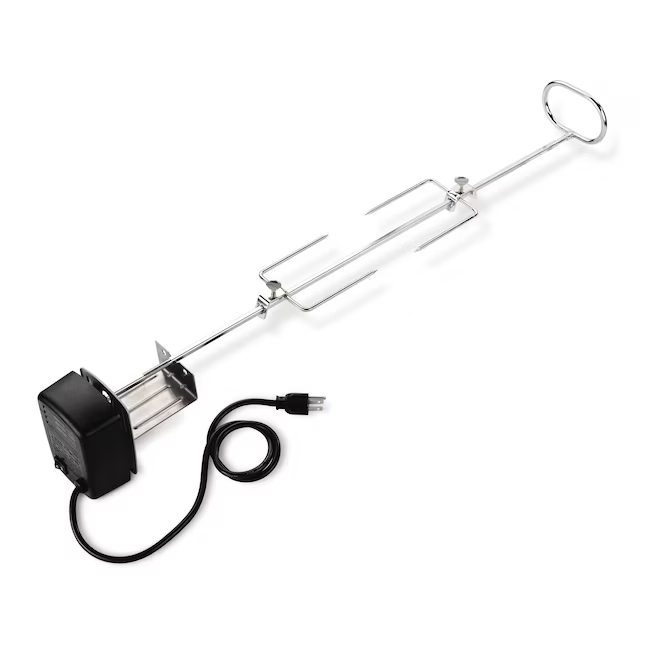
To set it up, all you need to do is remove the grill grates (there is a handy place to hang them on the back), and add a clip on the side, and then add the rod.

I fired it up with a small chicken. The chicken developed some beautiful color on the outside and was super juicy. I had to see if it could handle a whole turkey, and it did not disappoint!
Having the option to add a rotisserie makes the Searwood even more versatile. It’s one of my favorite ways to do a Prime Rib, so I love that I can do it on the Searwood without having to setup my charcoal rotisserie.
Cleaning
I’m not a big fan of pellet grills where the grease drains to a pot on the side, so I was glad to see
Most of the pellet ash falls down into the catch under the grill, which can be easily dumped out. It’s a decent size, and it’s great to be able to easily clean it out without having to remove all the grates and deflectors.
To do a full clean of the cook chamber and fire pot, you’ll need to remove a few extra parts (flavor bar, cap, then heat deflector). Because a lot of the ash falls down, I went 5 or 6 cooks without touching it.

How well does the WiFi and app perform?
I’ll be the first to admit I’m not a big app user when it comes to my smokers. That said, I know it’s an important feature for a lot of people, so I set it all up and made sure to use the app during my test cooks.

The WiFi worked flawlessly and I had no issues downloading the app and getting everything connected.
It’s nice to be able to quickly check your phone and see where all your temps are at. You can also activate SmokeBoost from the app, add temperature alerts and timers, and shut the grill down.
You also get access to
The competition
Since publishing our Searwood review, we’ve been asked repeatedly how it compares with the Woodwind Pro.

Considering the $300 price jump for the base Woodwind Pro, you would think it would be the obvious choice if you could afford it. The choice isn’t as obvious as you might think, especially if you’re looking to smoke and grill on a single pit.
We’ve compiled all of our thoughts into a detailed comparison, which you can check out if you’re interested.
The other obvious comparison point is

The main difference is that the Smoque strips out the high-heat grilling capability. While you can still get up to 500°F, which is fine for chicken or getting a light char on burgers, it struggles to get the deep sear we easily achieved on the Searwood.

If you’ve already got yourself a gas or charcoal grill and are looking for something purely for BBQ, the Smoque gives you 80% what the Searwood does.
But for my money, I’d much rather spend a little extra and get the full featured pit.
Should you buy the Weber Searwood?
After experiencing the SmokeFire rollout, I wanted to ensure I pushed this pit to the limit to detect any flaws.
I smoked pork and beef ribs, grilled steak, burgers, and pork chops, and even made smash burgers and a rotisserie chicken.
During that time, I’m happy to report no serious issues or deal breakers. I’ve got a couple it nitpicks for sure.
There are a couple of decisions
The benefit of this is that you can get the smaller Searwood for well under $1,000, and you have an incredibly versatile pit that can smoke and grill with features you only find on grills that go for well over $1200.
There’s also the rotisserie and griddle, which you can add at any time for even more versatility.
I wish I had gotten the 600 XL, but then I do catering and like to cook for a lot of people.
If you want a single pit that can do everything, the Searwood is the only pellet grill I would recommend at this price range.

About Your Pitmaster
Jeff “Ricer” Rice is the face of the Smoked BBQ Source YouTube Channel, where he brings expert BBQ equipment reviews and mouthwatering cook videos to life. A lifelong barbecue enthusiast, some of his fondest memories have been made around a pit, and he’s passionate about sharing that experience with others.
Whether he’s testing the latest gear or firing up the smoker, Jeff takes a real, no-nonsense approach to barbecue, making it easy for anyone to fire up great BBQ at home.
Great review. I’m glad I never went with Weber’s first round of pellet grills (SmokeFire) being all the issues it had. I’ll Keep my eyes on this one and hopefully, it’s worth buying and Weber did in fact learn from their mistakes. It does look promising.
I have a searwood 600XL
No disagreements on any points here. I have direct cooked chicken and burgers and smoked a pork butt, two briskets and some ribs so far.
I also baked 20 odd potatoes and grilled 15 corn cobs at the same time at one point.
The XL has a huge cooking surface area. I am really happy with it.
Thanks for your input Joe. Wish we had got the XL!
OK, this or the Camp Chef Woodwind Pro 24?
That is a real tough one! Actually working on a video comparing these two pits right now. The quick answer is if you want to focus on mostly smoking get the Woodwind Pro. If you want to do plenty of grilling, or want to be able to add the rotisserie, or griddle plates, get the Searwood.
Neither are bad options, so it’s really splitting hairs.
Can u use any pellets or do u have to buy the Weber pellets? If u can use non Weber pellets can u recommend brands that will work well.
Any pellets will work with any pellet grill. We have a list here that we use and recommend.
Just wondering have you tried the Grilla smoker/pellet grill, Silverbac.
How does it preform to the Weber 600xl to the Silverbac.
And any other input would be great.
I have smoked some. Really don’t know which is better 600, or 600xl, or the Silverbac.
Thanks Tim Kral
Hey Tim, we have tried the Grilla Alpha pellet grill, but not the Silverbac. We would pick the Weber over the Grilla, it’s got more features and versatility. As for 600 vs XL, it just comes down to how much food you want to cook at once. We have the smaller one but wish we had gone for the larger model.
I’ve been a pellet grill user since 2006 with a Traeger and a MAK 2 star general. This Searwood review was excellent showing the grill and its usage. Cleaning appears easy. I would want added shelf space.
Hey Richard, I’m glad you found our review of the Searwood helpful! That’s impressive, I would be curious to know what a Traeger was like back in 2006!
Watched your review and got the XL. It’s been great using it so far. Thanks for doing such a great review!