
Traeger VS Weber Searwood: Which Pellet Grill is Better?


SmokedBBQSource is supported by its readers. We may earn an affiliate commission at no extra cost to you if you buy through a link on this page. Learn more.
While Traeger has dominated the pellet grill market since they invented them back in the 1980s,
After stumbling onto the scene with the release of the SmokeFire a few years ago,
I’ve owned and smoked all the major Traeger models, including the Pro 780, Ironwood XL, and Timberline XL. For the last several months, I’ve been testing out the Searwood to see how well it competes. Read on to learn how these two brands compare so you can decide where best to spend your money.
 |
 |
|
Pros:
|
Pros:
|
|
Cons:
|
Cons:
|
- Better App
- Better cart design
- Interior grill light
- More expensive
- Direct flame searing across the entire grates
- Option to add griddle and rotisserie attachments
- Side shelves not included
Weber VS Traeger: Who Makes the Best Pellet Grills?
Comparing brands can be tricky because it’s not always obvious which models to compare.
When you look at the price, the smaller Searwood model sits between the Pro 575 and Pro 780.

However, in terms of features, the Searwood destroys the Pro. I don’t even think it’s close.
We’ve received many requests to compare the Ironwood, but that grill costs $600 more than the Searwood XL.
Then you have the Traeger Timberline XL, which will set you back $3799.99 before accessories.
I decided to compare the Ironwood, but since it’s such a jump in price, I’m also going to cover some of the best accessories
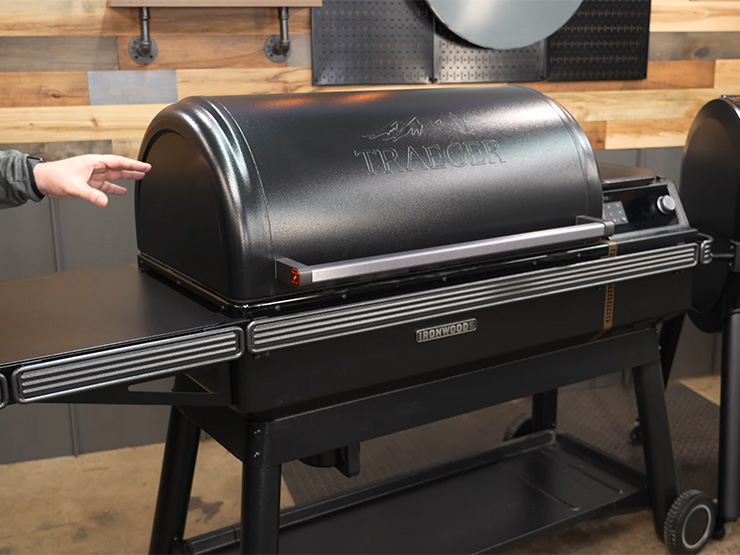
Then, if you decide to go for the
You can also learn more about both pits in our Searwood and Ironwood reviews.
Traeger Ironwood Vs Weber Searwood Head to Head

These two pits make the most sense for a head-to-head comparison because they share many similar features. If you’re more interested in the Pro, it will still be useful for you, though, and at the bottom, we’ll have a section comparing just the Pro.
In the photos, you’ll notice we have the smaller Searwood 600 and the larger Ironwood XL. Both brands sell a regular and a larger model, and the only difference between them is the size.
Specification Comparison
| Traeger Ironwood XL | Weber Searwood XL 600 | |
| Dimensions (IN)) W*D*H | 70 x 25 x 48 | 50.50 x 23 x 45.75 |
| Weight (lbs | 243 lbs | 157.80 |
| Cooking surface | 924 square inches (594 bottom + 330 top ) | 972 square inches (630 bottom + 342 top) |
| Max Temp | 165-500°F | 280-600°F |
| Hopper | 22 Lbs | 20 Lbs |
| Smoke Boost | Yes | Yes |
| Pellet Sensor | Yes | Yes |
| Interior Light | Yes | No |
| Warranty | 10 Limited Years | 5 Years (3 years on electrical components and cooking grates) |
| Price | Check latest price | Check latest price |
Build quality and design
Both the Traeger Ironwood and
The Traeger Ironwood weighs substantially more than the Searwood. Part of that comes down to the larger cart design with the integrated side shelf, but you’ve also got the powder-coated, insulated, dual-walled construction.

The

The Ironwood has a large side shelf and a heavy-duty bottom shelf, which provide ample storage for pellets, tools, and other barbecue supplies.
The
The
Cooking Space and Grates
The
The grill grates are made out of stainless steel and feel nice and heavy-duty duty. I would assume

I found the old Smokefire grates were a little better for searing. These aren’t bad, but given the Searwoods grilling capabilities, I found the downgrade strange. Maybe
The Traeger Ironwood has a slightly smaller 924 square inches of cooking space, with 594 on the bottom and 330 on the top warming rack.
The Ironwood’s grates are made of porcelain-coated steel. They’re fine for smoking, easy to clean although not the best for grilling.

The Ironwood comes with an internal grill light for nighttime cooking. It turns on automatically when the lid is opened.

Cooking Performance
The Traeger Ironwood excels in low and slow cooking, perfect for smoking meats to achieve that tender, fall-off-the-bone texture. When I cooked spicy spare ribs on the Ironwood, I was amazed by the depth of the smoke ring on the bones.
The grill also did an excellent job with beef cheeks, which were tender and flavorful.


I smoked a turkey on the Ironwood, and the color and taste were simply incredible. The grill’s temperature range of 165 to 500 degrees Fahrenheit allows for versatile cooking, but it might not be the best choice for high-heat grilling.
The
The higher temperature range makes it perfect for searing steak and chops and achieving those beautiful grill marks.
You swap the regular grates for the drop-in griddle for smash burgers and then use the rotisserie for wood-fired rotisserie chicken or even prime rib.


The Searwood was no slouch when it came to smoking either. I made no-wrap ribs and they came out nice and tender with a deep smoke ring a
Digital Controllers
The Searwood uses the “Rapid React™ PID” controller. It has a temperature range of 200-600°F and can be adjusted in 5-degree increments.
The controller has been designed to allow for open-lid grilling, something I’ve never seen on a pellet grill before.
In my tests, the Searwood got up to a smoking temperature of 225°F in 6 minutes.

You only get one meat probe included, although the controller has room for two so you can always expand.
The controller also has a smoke boost feature to if you want to increase smoke production.
The Traeger Ironwood grill is equipped with the D2 Direct Drive WiFire PID controller and boasts a temperature range of 165-500°F, adjustable in 5-degree increments.
Unlike the

The Ironwood controller also features a Super Smoke mode, which can be engaged between 165-225°F, and a Keep Warm mode, which runs between 165-195°F. These modes are perfect for maintaining the temperature of your barbecue until it’s time to serve.
The Ironwood controller has two probe ports and they include two color-coordinated probes.

The Traeger also supports Meater probes if you want a wireless solution. Just make sure you buy the Traeger X Meater version, as the other versions will not integrate with the grills controller.
Accessories
With the Ironwood, you get Traegers P.A.L Pop-And-Lock accessory system, which allows you to purchase various accessories, such as a front shelf, spice rack, tool hooks, and even a paper towel rack.

I like the flexibility this system offers, as I can position these accessories wherever I want.
While these accessories are nice, they are really just small upgrades and do not massively change your experience.
With the Searwood,

I was incredibly excited to test out the drop-in griddle, and it hasn’t disappointed me. Just remove the grill grates, drop the griddle in, and set the grill controller to the manual mode, which adjusts the pellet flow for open-lid grilling.

The rotisserie attachment is just as useful.
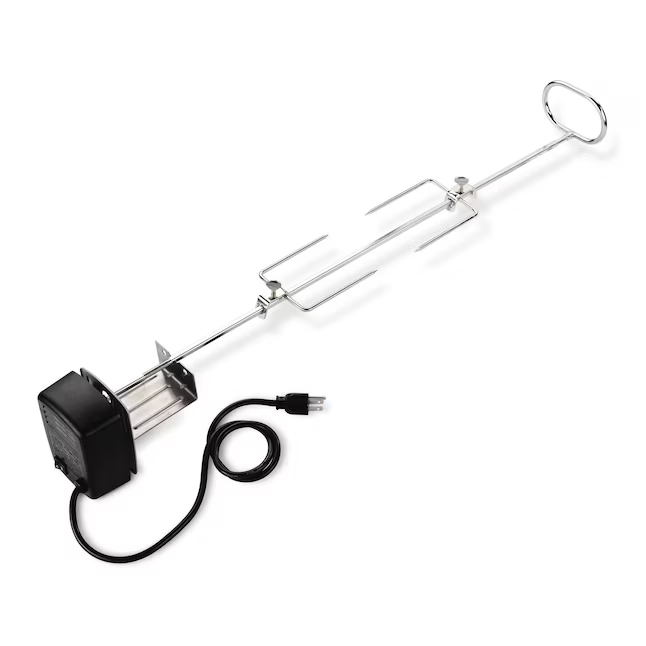
I tested it out with a rotisserie chicken, and it had the best smokey flavor I’ve ever tasted.

You’ve also got the CRAFTED system, which allows you to swap out the grate with various custom grillware, including a pizza stone and sear grates.
Apps and connectivity
The
You can also activate SmokeBoost or manual mode.
The app offers several guided recipes that walk you through the cooking process step by step, making it easier for beginners to get started with grilling and smoking.

Although the
The Traeger app is more polished and includes a more extensive library of recipes and guided cooking.

When comparing the two apps’ ratings on the App Store,
Cleaning and maintenance
Both grills have hidden ash and grease catches. This is something I expect to see on all pellet grills at this price level. I hate the old-fashioned tin grease can hanging off the side design
The Traeger Ironwood uses a removable canister to which you can add a standard grease liner. Save yourself the money and buy a bulk pack on Amazon rather than the Traeger branded ones.

You will still need to remove the grates and heat deflector to clean out the chamber every two to three cooks.

Weber integrated the ash and grease tray under the fire pot, and I found that more of the pellet ash fell into the catch during a long cook.

This makes it easy to keep on top of maintenance, so you can go longer before taking all the parts out for a deep clean with the shop vac.
Prep areas, storage, and wheels
The Traeger Ironwood has two locking casters and two wagon wheels. I wish they had gone for four casters, as I like to be able to roll my grill out of the garage quickly.

This probably won’t be a concern for many of you though.
The Ironwood still beats the Searwood for portability though.

There is a sturdy handle you can grab to lift up to maneuver the grill.
Value
Since the Searwood is much cheaper than the Ironwood, I wanted to compare what I consider the dream Searwood setup.
- Searwood XL – $1,199
- Folding Side Shelf – $74.99
- Folding Front Table – $99.99
- Rotisserie – $149.99
- Griddle Insert – $199.00
For a total price of $1722.97, which is still $77.02 less than the smaller Traeger Ironwood without any accessories.
I think that setup gives you much more versatility than the Ironwood.
Traeger vs Weber Video
This is an older video I made comparing the Traeger Ironwood to Smokefire. It’s still worth watching to see how the Ironwood works. I’m working on an update to show the Searwood, and in the meantime, you can watch my Searwood review video here.
So which pellet grill should you buy?
Both the Traeger Ironwood XL and the
The Traeger Ironwood is ideal for those who prefer low and slow cooking and prioritize build quality and app experience.
The
In my opinion, the

About Your Pitmaster
Jeff “Ricer” Rice is the face of the Smoked BBQ Source YouTube Channel, where he brings expert BBQ equipment reviews and mouthwatering cook videos to life. A lifelong barbecue enthusiast, some of his fondest memories have been made around a pit, and he’s passionate about sharing that experience with others.
Whether he’s testing the latest gear or firing up the smoker, Jeff takes a real, no-nonsense approach to barbecue, making it easy for anyone to fire up great BBQ at home.
This was a great article and I appreciate the comparisons as I’m looking at both of them. One thing that I never seem to see on any reviews or comparisons is how they handle in cooler temperatures. The Weber Cedarwood being single wall and not insulated, would it have an extremely hard time maintaining temperature in colder weather? Does the double wall insulation of the Traeger make that much of a difference?
Hi Mitch, it’s a fair point. We do all of our testing inside our indoor studio so we’re protected from those harsh Wisconsin winters, but it does mean we can’t really comment on how these grills perform in the cold. Just from using both of these pits though I don’t think you’ll have a huge difference.