
Types of Pork Ribs


SmokedBBQSource is supported by its readers. We may earn an affiliate commission at no extra cost to you if you buy through a link on this page. Learn more.


I’ll be honest. When I first got into barbecue I had no idea there were different types of pork ribs.
It wasn’t until I started buying meat from proper butchers that I realized how many options were out there for a rib fiend.
Learning about the four popular cuts of pork ribs and how they are butchered and trimmed is a great shortcut to mastering barbecue ribs.
So grab a coffee (or a beer) sit back and learn everything you never knew about the different types of pork ribs.
The 4 Main Types of Pork Ribs Explained
We can’t talk about the different cuts of pork ribs without looking at the anatomy of the pig.
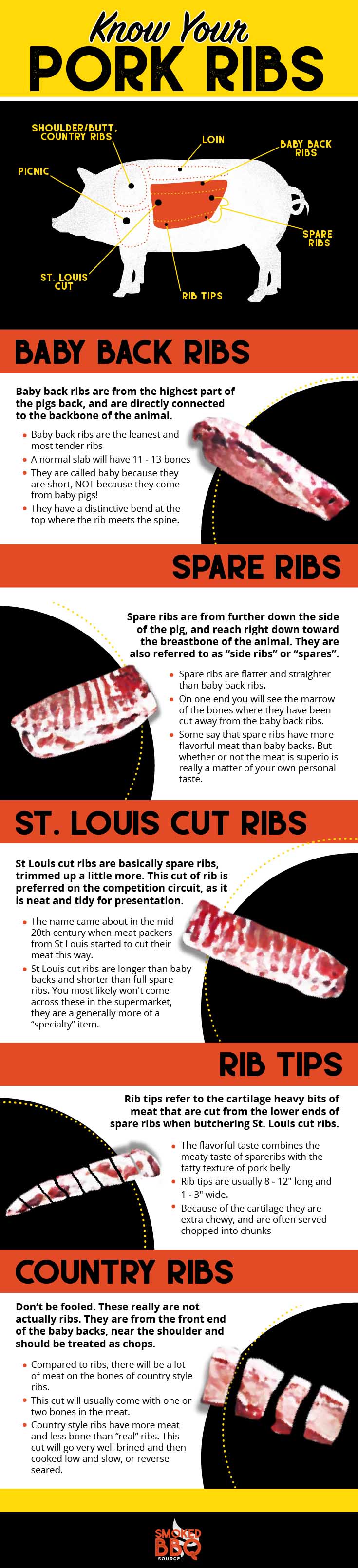
Each pig has 14 rib bones which are attached to the spine and divided into the four most popular cuts.
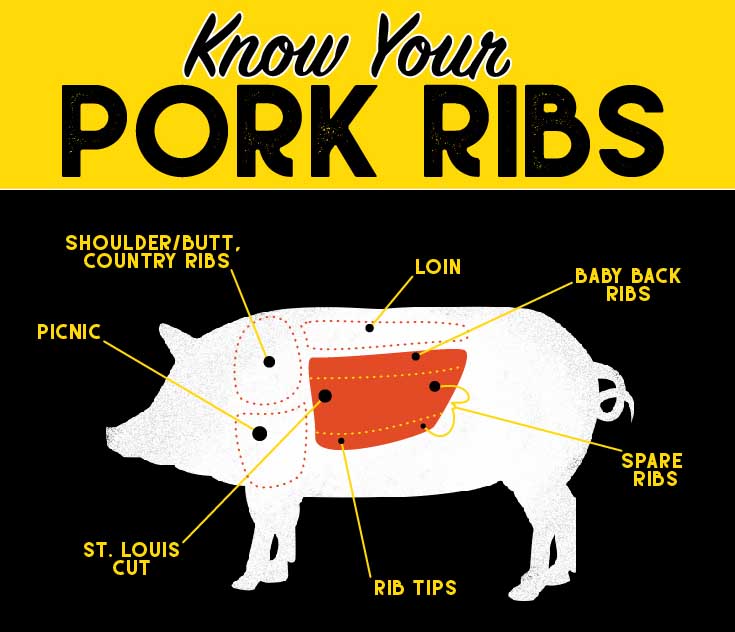
The type of rib will depend on it has been trimmed, and the section of the rib cage from which it has been cut.
Each type of rib has its own distinct characteristics, number of ribs in a rack, and ways to prepare.
1. Baby Back Ribs

Baby back ribs are from the highest part of the pigs back, and are directly connected to the backbone of the animal.
Just to be clear, these ribs have nothing to do with piglets. The word “baby” refers to the fact they are smaller than spare ribs. “Back” refers to the fact that they are attached to the backbone of the pig.
They are also sometimes referred to as “loin back ribs”.
Distinctive Features:
- Baby back ribs tend to be leaner than spare ribs.
- They usually range between 3 to 6 inches in length from long end to short end
- They have a distinctive bend at the top where the rib meets the spine.
How to prepare baby back pork ribs
There are so many great ways to cook baby back ribs. All good recipes will include the same basic steps:
- Look for ribs that are around 1 inch thick with plenty of meat
- Trim any meat dangling from the bone side
- Slide the tip of a knife under the membrane and over the bone
- Using a paper towel carefully pick up the edge of the membrane and peel it off. Learn more about how to remove the membrane from pork ribs in our step-by-step guide.
- Season both sides with your favorite barbecue rub
For more detailed cooking instructions I recommend this recipe for smoked baby back ribs on the pellet grill, or if you are short on time, go for our hot and fast baby back ribs recipe.
Another popular option is to slice the ribs before smoking them. These are known as party ribs.
2. Spare Ribs

Spare ribs are from further down the side of the pig and reach right down toward the breastbone of the animal. They are also referred to as “side ribs” or “spares”.
These are probably the most popular type of rib, and when people refer to “ribs” without specifying what type, there is a good chance they are talking about spare ribs.
Distinctive Features:
- Spare ribs are flatter and straighter than baby back ribs.
- On one end you will see the marrow of the bones where they have been cut away from the baby back ribs.
- The other end is where the ribs taper away at the chest of the animal. At this end of the ribs you will see a slab of meat, along with some cartilage and gristle.
- Some would say that spare ribs have richer, more flavorful meat than baby backs. But whether or not the meat is superior or not is really a matter of your own personal taste.
If you’re having trouble telling apart baby back ribs from spare ribs, we have a whole post dedicated to the subject.
How to prepare pork spare ribs
You can prepare spare ribs the same as baby back ribs just increase the cooking time. While baby backs can be finished in 3 to 4 hours, when cooking spare ribs, allow 5 – 6 hours.
For a great pork spare ribs recipe, check out our guide to 3-2-1 ribs as well as Johnny Trigg ribs recipe.
3. St Louis Cut Ribs
St Louis cut ribs are basically spare ribs, trimmed up a little more. This cut of rib is preferred on the competition circuit, as it is neat and tidy for presentation.
The meat is pretty much the same as that you would find on spare ribs, minus the cartilage and gristle you find at the bottom of the spares.
The name came about in the mid 20th century when meat packers from St Louis started to cut their meat this way.
Distinctive Features:
- St Louis cut ribs are longer than baby backs and shorter than full spare ribs.
- You most likely won’t come across these in the supermarket, they are a generally more of a “specialty” item.
- While the shape of the bone is essentially the same as the spare rib, the fact that they are trimmed up more makes them look more regular in shape than other types of rib.
How to prepare St. Louis ribs
Getting the St Louis cut in your local grocery store may not be possible. But you can trim up some spare ribs yourself if you like St Louis cut ribs.
We have a detailed guide on how to trim spare ribs and we’ve also broken it down step by step for you below.

But before you start, make sure you have a sharp boning knife – this will make the whole task much easier.
- “Square up” your ribs. This means cutting off the pointy-looking end of the ribs to make the rack rectangular in shape.
- Take off the membrane as described in the section above.
- Feel for the point that the bones end within the meat. Cut along this line to make the rack rectangular in shape, in line with the ends of the bones.
- Have a look for any other fatty protuberances that can be trimmed up.
The meaty piece that you have taken off is sometimes referred to as the brisket of the pork. At other times it is called rib tips. Either way, it can be cooked and eaten as well, so don’t throw it away!
What you have now is a St Louis style cut! Congratulations,it is neatly trimmed and ready for the smoker.
Once trimmed up you can cook them however you like. We have a St. Louis Ribs recipe on a gas grill, but you can use the same technique on any smoker.

4. Rib tips

Rib tips refer to the small bones and cartilage that connect the front ribs to the breast bone.
They are cut from the lower ends of spare ribs when butchering St. Louis cut ribs. Don’t confuse rib tips with riblets which are actually not ribs at all!
Rib tips used to be discarded as waste, but have started to make a big comeback.
Distinctive Features:
- Rib tips are usually 8 – 12″ long and 1 – 3″ wide.
- Because of the cartilage they are extra chewy, and are often served chopped into chunks
How to prepare rib tips
If you don’t want to buy the full spare rib and trim your own rib tips, you should be able to buy them from a good butcher.
Smoked rib tips make delicious appetizers and can cook in 2-3 hours. They can also be used for Asian-style recipes like these delicious Chinese rib tips.
What about country style ribs?
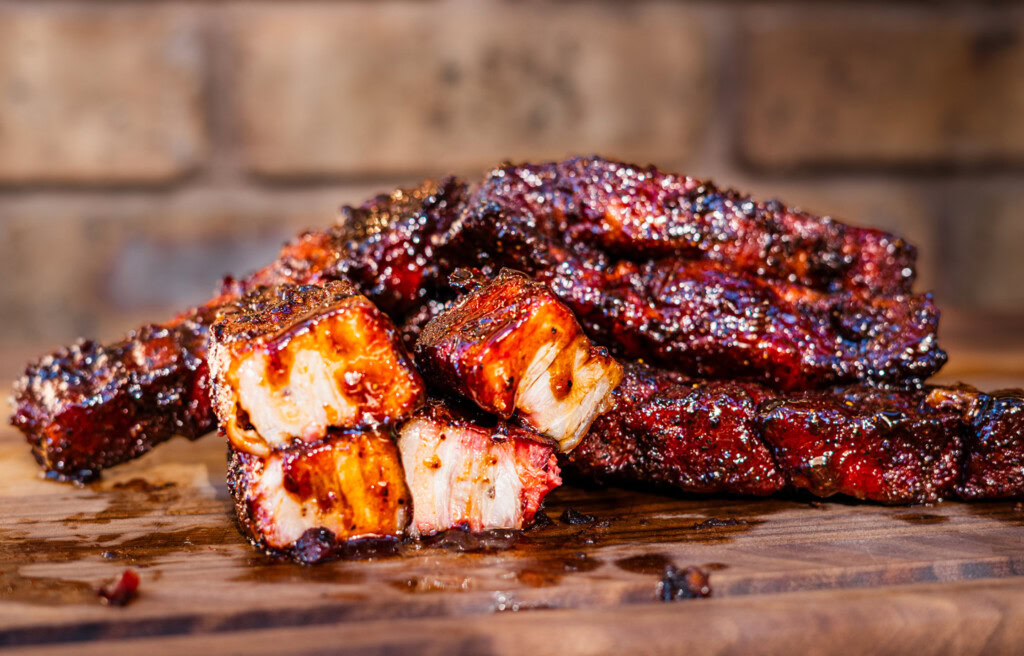
Don’t be fooled. These really are not actually ribs.
Country-style ribs actually come from two different parts of the pig. The most common version is cut from the pork shoulder, while the less common version comes from the tail end of the loin.
Either way, they’re meatier than traditional ribs and have more fat and connective tissue, which makes them well suited to low and slow cooking. Learn how to smoke them in our smoked country style ribs recipe.
Distinctive Features:
- More meat and less bone than traditional ribs, depending on the cut some may have no bone at all.
- The shoulder-cut version behaves like a pork butt and suits a long smoke or braise. The loin-cut version is leaner and cooks faster, closer to a thick pork chop.
Other types of pork ribs
While the United States Department of Agriculture has specified some cuts of meat, a lot of the different names and cuts you hear are made up over time and vary by location.
Here are some of the common names you’ll hear:
- Back ribs / loin ribs – Both refer to baby back ribs
- Kansas city style ribs – Similar to St. Louis style but not trimmed as closely
- Riblets – Made by taking a full slab of ribs and cutting them so the bones are only half as long. This makes smaller portions which are pefect for appetizers or kids
- Button ribs – Often confused with rib tips, these were made famous by Applebee’s. Thin strips of meat and bone are cut from the side of the pigs spine.
Wrapping it up
Smoking some killer ribs is a classic skill in the world of barbecue. Perhaps for this very reason, there is a lot of information out there about how to cook the best pork ribs.
But as with most things barbecue, a bit of extra knowledge and some experimentation is the best way to get the results you are after. You might also want to check out our guide to different types of beef ribs.
What’s your favorite cut of ribs to cook?
Let us know in the comments section below. And if you found this article helpful, don’t forget to share!

About Your Pitmaster
Joe Clements is the founder and editor-in-chief of Smoked BBQ Source, a leading barbecue resource that has helped tens of millions master grilling and smoking. Growing up in a vegetarian household, his love for barbecue was unexpected. Determined to master the craft, he launched Smoked BBQ Source in 2016 to document his journey from amateur to pitmaster.
Joe leads a team of expert barbecue creators and oversees the largest collection of in-depth grill reviews and a library of tested, foolproof recipes. Whether he’s firing up a pellet grill or charcoal kettle, he’s passionate about making barbecue approachable and enjoyable for all.
My husband likes ribs with bone tips he can chew easily to get to the marrow. Is this one type of rib or another? One person told me to boil them first, but I don’t know if this is correct. I would like to hear from a pro on proper technique. Thank you
This post was SO helpful! Now I’ll feel a bit more confident picking out ribs with the butcher, thank you!
Excellent tutorial. Thank you.
Very detailed and concise, I’m very happy to find this post. Thank you so much. Truly appreciated.
I been smoking baby backs and spare ribs for years and never really gave it much thought as to the origin of the cuts.
Thank you very much for educating me further for in picking out a better choice to smoke. Very detailed article.
I prefer baby back ribs for smoking. I use the 3-2-1 method. 3 hours at 225 spritzing every hour, wrap in tin foil for 2 hours and then unwrap sauce up and smoke for 1 more hour. Yum. Love your articles.
I enjoyed your article on Rib styles. It was very informative and easy to understand.
You mentioned country style what about western style????
Western style ribs have nothing to do with bones, but are pieces of boneless shoulder meat cut to the shape of meaty ribs.
I used to by high-end country ribs at Fresh Market. They included a back rib and cooked up like back ribs. The butchers would keep these in the back and I had to request them. The butchers would reluctantly bring them out, and I concluded that they were saving these premium cuts for themselves. If ever you see such cuts in the pork section, they are often priced higher than the boneless variety. I buy them without question.
I have been eating ribs for about 70 years, buying and cooking them for over 50 years.
During one visit to Chicago (home town), I ordered and ate 9 meals worth. Don’t do that. Here are two corrections to the above discourse.
1. Decades ago, some restaurants and markets would import ribs from Denmark, and they came in 10-pound bags for retail sales. The Danish porkers are smaller than U.S. animals; the ribs were much thinner. The meat was (and still is) tender and flavorful, and American producers competed by developing and marketing smaller animals. Trouble was, consumers were confused by the appearance.
” AHA!” said the marketing genius, “we’ll call these junior size bones Baby Back Ribs,” and everyone bought into it. But if you go to the major supermarkets (and Costco), they still sell the “regular” back rib slabs, which are much bigger and meatier than the so-called baby backs.
2. Several butchers corrected me when I asked them to remove the membranes from the underside of the slabs. “That is not a membrane; that is the skin”.
3. No matter the cut, I simmer them in salted water for 90 minutes and remove the pot from the heat, letting it cool down for a half-hour. At that point, they are fully-cooked, and I sometimes rub in some liquid smoke.
4..Season and flavor as you wish, but never omit charring them on the grill or under the broiler before serving. My son and brother both swear my ribs are better than they get at the top bbq restaurants.
Hey Guys what temperature would I smoke the ribs using the 321 method in a cabinet smoker?? Thanks
Can’t go wrong with 225-250
Great information. I’ve been eating ribs for decades but never bothered to find our why I liked some more than others. Now I know why00 I prefer the St. Louis cut. Had asked google to compare St. Louis and Kansas City ribs and your site came up. Thanks for easily understandable post.
I think there is something to be said about leaving the ribs just plain a little salt and pepper when I do use seasoning rub them up night before and take membrane off I smoke mine for 4 hours hickory smoke then put in foil for two hours then wet sauce if it calls for it last time I cooked one rack with just a little salt and pepper and the 4 hours hickory smoke
I liked them just as much as others maybe more.Happy Grillin
Great post! Thank you. Love the easy explanations.
Great article! Now I know what I’m eating! Thank you for explaining ribs so thoroughly and making it easy to understand.